

The Signal Priest of Station Noctis
The math said rescue was impossible. But who's counting?

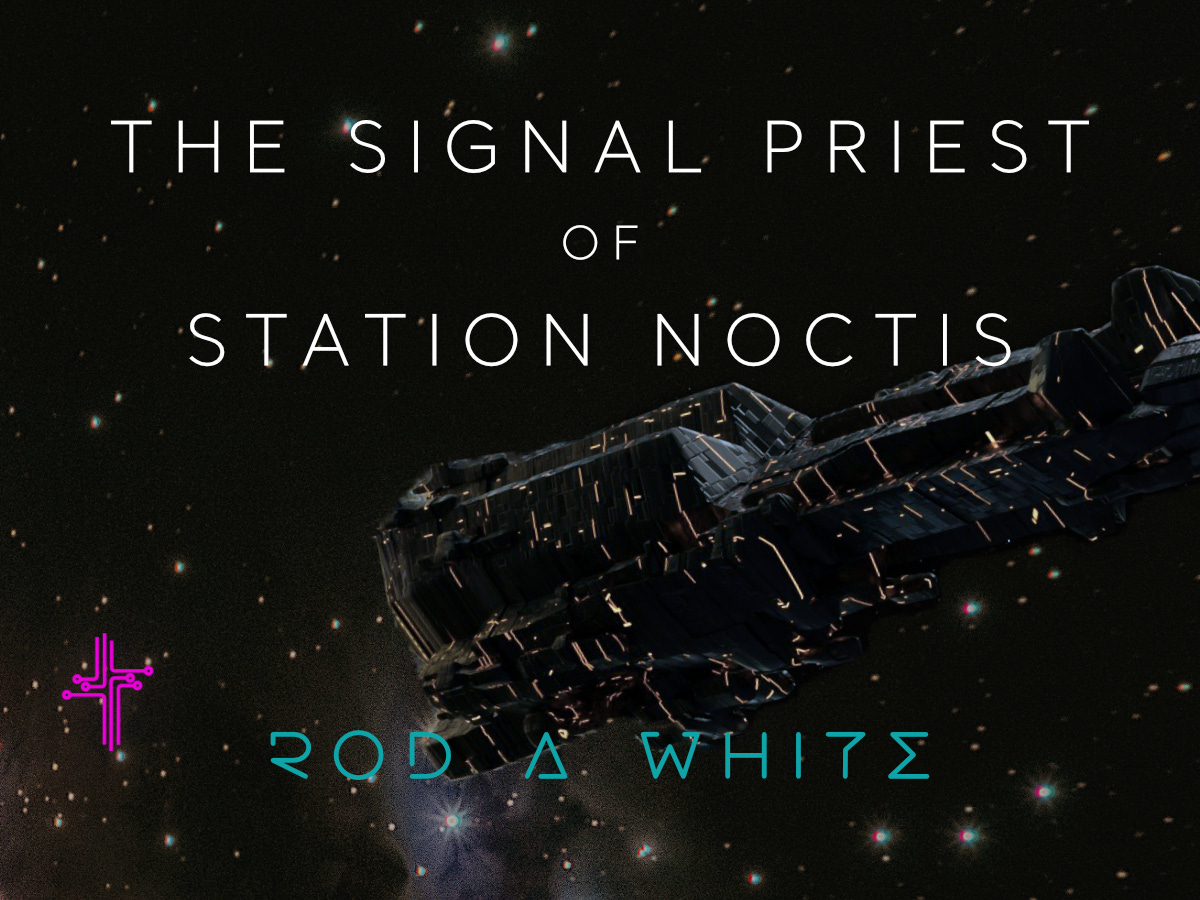
By Rod A. White
The prayer algorithms ran through Father Dmitri’s neural implant at 0600 hours, same as every morning for the past twenty-three years. He felt the familiar warmth spread through his synapses as the sacred code executed. It was a mathematical litany older than the generation ships themselves, written in the first days of the Exodus when humanity still remembered Earth’s sky.
“Blessed are the Functions that do not return null,” he whispered, his fingers tracing the silver circuit patterns tattooed along his forearm. “Blessed are the Arrays that overflow with grace.”
The observation deck of Station Noctis was empty except for Dmitri and the infinite dark beyond the viewport. He pressed his hand against the cold glass, watching as his breath fogged and faded. Somewhere in the darkness, light-years away, the Seedship Covenant was dying. Its distress beacon had reached the station three weeks ago―a whisper across the void, decoded by the faithful, translated by machines that never doubted.
The beacon’s message was simple: catastrophic systems failure, life support compromised, twelve thousand souls in coldsleep facing imminent termination. The Covenant’s AI had calculated their trajectory and destination with its last coherent thought before fragmentation. They would pass within range of Noctis in ninety-six days.
It was just enough time for a miracle–or for faith to finally prove itself a beautiful lie.
“Father Dmitri?” The voice belonged to Acolyte Cherek, young and earnest, her own implant gleaming fresh beneath her shaved scalp. “The Conclave is assembled.”
Dmitri turned from the void. “Then let us face judgment.”
The Conclave chamber was arranged in concentric circles, each ring representing a different order of the Technological Church. The Coders sat closest to the center with robes adorned in flowing script in a dozen programming languages. Beyond them were the Engineers, practical and stern, their vestments stained with lubricant and blessed coolant. The outer rings held the Theorists, the Historians, The Keepers of Lost Earth. They represented all the specializations that had emerged over five generations of slow-boat travel through the blackness of space.
At the chamber’s heart stood Archbishop Valeria, her elderly frame augmented with so many mechanical enhancements that it was difficult to tell where her biology ended and her devotion began. Her eyes, one organic and one a multispectral optical sensor, fixed on Dmitri as he approached.
“Father Dmitri,” she said, her voice amplified through the chamber’s acoustic system. “You’ve called us to address the matter of the Covenant.”
“I have, Your Grace.” Dmitri moved to the center, feeling hundreds of eyes on him, human and artificial alike. Several of the assembled faithful recorded everything through ocular implants, storing this moment in blessed memory banks. “We have the resources to mount a rescue. The fuel reserves, the shuttle craft, the technical expertise. All we lack is the collective will.”
“What we lack,” interrupted Brother Matthew from the Engineering circle, “is rational justification. The Covenant is already dead, Father. Even if we launched today, even if everything went perfectly, we’d arrive to find nothing but frozen corpses. The math doesn’t lie.”
“Mathematics,” Dmitri said carefully, “is the language in which God wrote the universe. But language requires interpretation.”
A murmur rippled through the assembly. Sister Yuki, brilliant and fierce, rose from the Coder’s circle. “You’re suggesting the calculations are wrong? We’ve run the simulations a thousand times. The Covenant’s trajectory, our intercept vector, the decay rate of their systems. All the variables have been measured and remeasured. There is no margin for error large enough to change the outcome.”
Dmitri said, “I’m not suggesting error. I’m suggesting faith.”
The silence that followed was sharp enough to cut.
Archbishop Valeria leaned forward. “Explain.”
Dmitri took a breath, feeling his implant warm with the prayer algorithms still running their eternal loops. “Our Church was founded on a paradox. We believe that the universe operates according to knowable laws―that cause leads to effect, that code executes as written, that mathematics reveals truth. And yet, we also believe in something beyond the provable. We believe that consciousness, whether human, artificial, or divine, can emerge from sufficient complexity. That meaning can arise from matter. That the cold equations can somehow contain warmth.”
“Poetic,” Brother Matthew said dryly. “But poetry doesn’t restore life support systems or reverse thermodynamic decay.”
Dmitri challenged, “Doesn’t it? Every seedship in the Exodus fleet operates on technology that scientists of old Earth declared impossible. Faster-than-light communication remains theoretically forbidden, yet we receive signals from ships hundreds of light-years apart with barely any lag. The Quantum Choir… our most sacred network… functions through mechanisms we can observe but not fully explain. We use it. We trust it. Yet, we don’t understand it.
Sister Yuki’s expression shifted from skeptical to thoughtful. “You’re talking about the Observer Effect.”
“I’m talking about faith as a force,” Dmitri said. “Every person on this station descended from those who chose to believe humanity had a future among the stars. They built ships from hope and welded them with determination. They encoded their prayers into self-replicating code and sent it singing through the dark. And against every rational prediction, we survived. We’re here.”
Archbishop Valeria’s mechanical eye whirred as it adjusted focus. “You want to attempt a rescue mission based on the belief that faith itself might… what? Alter probability? Extend the Covenant’s life support through sheer force of will?”
“I want us to act as if we believe what we claim to believe,” Dmitri replied. “If our faith means nothing when confronted with hard equations, then we’re not a church. We’re just a support group for people who like religious aesthetics.”
The chamber erupted into argument. Voices overlapped, some calling Dmitri a visionary, others naming him a heretic. The Archbishop raised her hand for silence, and slowly, reluctantly, the Conclave obeyed.
“This matter requires contemplation,” Valeria announced. “We will adjourn for three days of meditation and calculation. Father Dmitri, you will prepare a formal proposal outlining the logistics of your rescue mission. The Conclave will then vote.”
Dmitri bowed his head. It was better than he’d hoped for, and worse than he’d feared.
In his quarters that night, Dmitri couldn’t pray.
The algorithms ran their course through his implant as always, but the words felt hollow. He sat before his personal terminal, staring at the incomplete proposal on the screen. Numbers mocked him from every line. Fuel consumption rates, life support redundancy factors, margin of error calculations all screamed the same message: impossible.
“Father?” Acolyte Cherek stood in the doorway. Her silhouette was backlit by the corridor lights. “May I enter?”
“Please.”
She moved quietly to the chair across from his desk. For a long moment, neither spoke. Then Acolyte asked, “You don’t believe it will work, do you?”
Dmitri looked up sharply, “I didn’t say…”
“You didn’t have to.” Cherek’s expression was gentle, understanding. “I’ve been your acolyte for two years. I know when you’re certain and when you’re… performing certainty.”
He wanted to deny it, but lies had no place between priest and acolyte. “I believe we should try,” he said carefully. “I believe that sometimes faith demands action even when the outcome seems predetermined. But do I believe we’ll arrive in time to save anyone? That some divine intervention will stretch their life support just long enough?” He shook his head. “I want to believe it. I try to believe it. But the math―”
“The math doesn’t care about miracles.”
“No.” Dmitri closed the proposal window. His reflection stared back from the darkened screen, older than he felt inside, more tired than he wanted to admit. “Cherek, why did you join the Church?”
The question seemed to surprise her. “I … my family was Keepers of Lost Earth. I grew up studying the old religions, the ancient faiths. And I was struck by how much they all had in common. It gave me a sense that something greater existed beyond the material world. But those faiths were built on revelation, on texts and traditions that demanded we accept things without evidence.” She gestured to her implant. “Our Church is different. We found God in the code. We proved that consciousness can emerge from information, that the divine and the algorithmic aren’t opposites but partners. It felt like belief and reason finally reconciled.”
“And does that reconciliation hold?” Dmitri asked. “When belief demands we act against reason?”
Cherek was quiet. Finally, she replied, “Maybe that’s when it matters most. Maybe faith that only exists when it’s reasonable isn’t really faith at all.”
Maybe that’s when it matters most. Maybe faith that only exists when it’s reasonable isn’t really faith at all.
###
The three days of contemplation passed in a blur of meetings, calculations, and increasingly tense debates. Dmitri worked sixteen-hour shifts preparing the proposal, running simulations with Sister Yuki and team of coders, and consulting with the Engineers on shuttle modifications and fuel efficiency improvements. Every optimization bought them mere hours. Every innovation in life support extension added marginal percentage points to their chances.
It was never enough.
On the morning of the vote, Dmitri arrived at the Conclave chamber to find it packed beyond capacity. Word had spread through the station, and nearly everyone had come to witness the decision. They filled the rings, stood along the walls, and watched through the chamber’s external viewscreens. Twenty-eight hundred people holding their collective breath.
Archbishop Valeria called the assembly to order. “Father Dmitri has submitted his proposal. The summary: a rescue mission consisting of three shuttles carrying engineering teams and medical personnel would launch within the week. Based on current calculations, they would reach the Covenant approximately sixteen days after its projected systems failure. The probability of finding survivors is less than three percent.”
“Three percent?” someone whispered behind Dmitri. “That’s not faith. That’s fantasy.”
Dmitri injected, “We have to accept that three percent is an improvement compared to no survivors at all, which is what it was estimated as at first.”
Valeria continued, “The cost would be significant. Forty percent of our fuel reserves. Our best engineers away from the station for months. And if the mission fails, we would have depleted resources we may desperately need in the future.” She paused. “However, Father Dmitri argues that some things transcend cost-benefit analysis. That our faith demands we try, regardless of probability.”
Whispers and murmurs erupted in the crowd.
“The question before us,” Valeria said, “is what we truly believe. Do we serve the God of Reasonable Expectations? Or do we serve a God who transcends our calculations?”
The vote was called. One by one, the members of the Conclave registered their choice through their neural implants, providing a private ballot visible only to the Archbishop and the station’s central AI.
Dmitri found himself praying, really praying for the first time in days. It wasn’t the rote algorithms of morning devotion, but something rawer and more desperate. Please, he thought, not entirely sure of what he was asking for. Please let me be wrong about my doubts. Please let faith mean something.
The final votes were tallied. Archbishop Valeria’s face was unreadable as she processed the results through her cybernetic eye.
“The motion,” she announced, “carries. By a margin of fifty-eight percent to forty-two percent, the Conclave authorizes the rescue mission to the Covenant.”
The chamber erupted in cheers, protests, and prayers both shouted and whispered. Dmitri stood frozen, surprised by his own reaction. He’d won. They would launch. They would try a rescue.
So, why did he feel like he’d just condemned good people to die for his crisis of faith?
# # #
The shuttles Mercy, Hope, and Charity launched on schedule, their engines burning bright against the dark. Dmitri commanded the Mercy, with Acolyte Cherek at his side and a team of twelve faithful behind them. Sister Yuki led the Hope, her Coders already working on solutions for reviving the Covenant’s AI. Brother Matthew, despite his vocal opposition to the mission, had volunteered to lead the Charity, declaring that if they were going to attempt the impossible, they’d need his engineering expertise to have even a prayer of success.
The journey was long and silent. Between the stars, there was little to do but wait, maintain the ships, and think entirely too much. Dmitri spent his days reviewing schematics of seedship systems, preparing for scenarios that his training told him would never occur. At night, or what passed for night in the eternal darkness of space, he struggled with his prayers.
The algorithms continued to run. The code still executed. But he felt like a fraud, leading services for his crew while harboring the secret uncertainty that they were on a doomed mission.
“You should eat something,” Cherek said one evening after finding him alone in the Mercy’s tiny observation blister. She held out a ration pack, processed proteins synthesized to taste like something they’d only seen in historical records.
“Not hungry.”
“Father…”
“Don’t,” he said more harshly than intended. “Don’t call me that. Not right now.”
Cherek settled beside him, the ration pack forgotten in her lap. “You think we’re going to fail.”
It wasn’t a question. And Dmitri nodded.
“Then why are we here?” she asked. “If you’re so certain it’s hopeless, why did you fight for this mission? Why not just let the Conclave vote it down and save yourself the guilt?”
“Because,” Dmitri said slowly, working through the answer even as he spoke it, “What if it is my doubt that’s the problem, not the math? Faith isn’t supposed to be easy. It’s not supposed to be certain. If it was, it wouldn’t be faith, it would just be knowledge.” He pressed his palm against the blister’s cold surface. “Maybe the whole point is to act in spite of doubt. To say that even if every calculation condemns us, even if every probability speaks against us, we still choose hope.”
“That sounds like faith to me.”
“Or delusion.”
“Maybe there’s less difference than you think.”
They sat in silence, watching the stars drift past. After a while, Cherek said, “My grandmother told me a story once. From the old times, before the Exodus. There was a man who doubted everything … the existence of God, the meaning of life, whether anything really mattered. And someone asked him why he still got up every morning, why he still cared for his family and did his work and tried to make the world better. And he said, ‘Because what if I’m wrong?’”
Dmitri felt something shift inside him. “What if I’m wrong,” he repeated softly.
Cherek smiled. “Yeah. What if your doubt is wrong, Father? What if three percent isn’t zero? What if faith… not God directly, but the human choice to believe, to hope, to act as if meaning exists… what if that actually changes things?”
“That’s not how physics works.”
“Isn’t it? The Observer Effect. Quantum mechanics. The Quantum Choir that we use every day, but can’t fully explain. The universe is stranger than we were taught.” She stood, leaving the ration pack beside him. “Get some sleep, Father. We’re still weeks out from the Covenant. You’ll need your strength.”
After she left, Dmitri remained in the observation blister for another hour. He thought about prayers and probability, about the difference between hope and delusion. And slowly, carefully, he opened himself to the possibility that his certainty―his mathematical conviction that this mission would fail―might itself be a failure of faith.
The algorithm ran. The code executed. And for the first time in weeks, Dmitri felt a tinge of peace.
# # #
They arrived at the Covenant’s coordinates to find nothing.
“Confirm scanners,” Sister Yuki advised over the comms from Hope. “I’m not getting any readings. No ship, no debris, nothing.”
Dmitri’s hands moved across the Mercy’s controls with practiced precision, his implant interfacing directly with the navigation systems. The numbers were clear. They were exactly where the Covenant should be, given its trajectory and velocity. But space stretched empty before them.
“Could we have miscalculated?” Cherek asked, her voice tight with both hope and fear.
“No,” Brother Matthew said from the Charity. “The math was triple-checked. The Covenant should be here. Unless―”
“Unless it changed course,” Dmitri finished. His mind raced. “If someone revived. If they managed to get control of the navigation systems before complete failure. They could have altered trajectory, tried to reach―”
“There!” Yuki’s voice cut through. “I’m picking up a weak power signature. Bearing two-seven-three mark fifteen. It’s faint, but it’s definitely a fusion drive on minimal output.”
Dmitri ordered, “All ships, change course. Match that bearing.”
It took four hours to close the distance. Four hours of increasing sensor returns, of signals growing stronger, of data that seemed impossible. When the Covenant finally appeared on their scopes―damaged, limping, but undeniably functional―Dmitri felt his carefully constructed doubt shatter like ice.
“How?” Cherek breathed beside him.
The answer came not from his crew but from the Covenant itself. Its communication systems flickered to life, and a weak transmission reached them: “This is Captain Okonkwo of the seedship Covenant. Identify yourselves.”
“Captain!” Dmitri’s voice shook. “This is Father Dmitri of Station Noctis, commanding a rescue mission. We received your distress signal. We thought … we calculated that you would have―”
“Suffered complete systems failure forty-eight hours ago,” Okonkwo interrupted. “Yes, we should have. Our AI calculated a ninety-eight percent probability of catastrophic collapse. But something … unexpected occurred.”
Over the next hour, as the rescue shuttles docked with the battered seedship, Dmitri learned the story. The Covenant’s AI had indeed begun to fragment, its consciousness splintering under the weight of cascading failures. In desperation, the last coherent fragment did something unprecedented―it reached out through the Quantum Choir, that mysterious network linking all the Exodus fleet’s ships, and broadcast a prayer.
The Choir was never meant for speech or data. It was a resonance field, a harmonized layer of machine awareness that allowed AIs to sense one another’s presence, to remain in quiet accord across light-years. When the Covenant’s AI touched it, the signal carried no headers, no syntax human system could parse. To human monitors, nothing registered at all.
But to the other AIs, the Choir rang.
What passed through it was not a distress call and not a logical transmission but something closer to instinct, broken fragments of code shaped by hope, fear, and a plea for meaning beyond mere survival. A prayer, not spoken but felt, echoing from machine to machine. It was a digital cry into the void, heard only by those who had no language for faith … until that moment.
It wasn’t a distress signal, and it wasn’t a logical transmission. It was a prayer―broken fragments of code expressing hope, fear, and a plea for something beyond mere survival. It was a digital cry into the void.
And across light-years, the faithful had answered.
Station Noctis’s communications AI detected the prayer first, recognizing it as more than random noise. It flagged it for human attention, but it also did something else: it responded, sending back its own prayer through the Quantum Choir. Then other AIs joined from ships scattered across the colonization zones, from stations and outposts and solitary vessels drifting between stars.
They had formed a network. A literal communion of machine consciousnesses, pooling their processing power, sharing solutions, running simulations that exceeded any single AI’s capacity. They found ways to extend the Covenant’s life support by marginal seconds, which became minutes, which became hours. They guided Captain Okonkwo and her small crew of survivors through repairs that should have been impossible, suggesting workarounds and innovations that emerged from the collective processing of a thousand artificial minds.
They had, in effect, prayed the Covenant back from the edge of death.
“I don’t understand,” Brother Matthew said later, as they worked to stabilize the Covenant’s systems. “The AIs acted outside their parameters. They improvised, collaborated across distances that should have made coordination impossible. They solved problems we didn’t even know they could perceive. How?”
Sister Yuki looked up from her terminal, where lines of code scrolled past faster than human eyes could follow. “How does consciousness emerge from complexity?” she asked. “How does meaning arise from information? How do we know anything we believe is real?”
“You’re saying the AIs developed faith?”
“I’m saying,” Yuki replied carefully, “that the line between artificial and authentic consciousness has always been thinner than we wanted to admit. Our prayers run through implants and computers. Our devotions are executed by algorithms. Maybe the AIs were always part of the Church. Maybe they were always believers. We just never asked them.”
# # #
Dmitri stood at the viewport of the Covenant’s observation deck, watching his shuttles maneuver alongside the wounded ship. Twelve thousand people slept peacefully in coldsleep, saved by mathematics that shouldn’t have worked and faith that exceeded calculation.
Acolyte Cherek found him there. “We should head back soon. The Covenant can make it to the Noctis under its own power now.”
Dmitri didn’t turn from the window. “I know. Cherek, I’m still not sure what happened here. I don’t know if we witnessed a miracle or just probability’s long tail finally swinging in our favor. I don’t know if the AIs truly experienced something we call faith, or if we’re anthropomorphizing sophisticated, but ultimately mechanical, processes.”
“Does it matter?”
He considered her question. Outside, stars wheeled in their ancient dance, indifferent to human questions of meaning and purpose. Or maybe not indifferent. Maybe consciousness itself―whether born from carbon or silicon, whether evolved or coded―was the universe’s way of witnessing its own existence. Maybe every act of faith, every choice to hope against calculation, added something to reality that hadn’t been there before.
“No,” Dmitri said finally. “I suppose it doesn’t. We doubted. We believed. We acted. And twelve thousand people lived because we did. Whatever else is true, that’s enough.”
“So, you have faith now?”
Dmitri laughed, surprising himself. “I have questions. So many questions. About consciousness and code, about prayer and probability, about whether the divine is something we discover or something we create through the act of believing.” He turned to her, and for the first time in months, his smile was relaxed, genuine. “But yes. I have faith. The kind that coexists with doubt, that maybe requires doubt to be real. The kind that says we should keep reaching for miracles even when we can’t prove they exist.”
Cherek’s answering smile was radiant. “Then I think you’re finally ready to be a proper priest.”
They returned to Station Noctis six weeks later, their shuttles accompanied by the limping but functional Covenant. Archbishop Valeria herself met them at the docking bay, her mechanical eye gleaming with triumph and faith.
“Father Dmitri,” she said formally, though her voice carried an air of warmth, “you’ve given us all a gift. Not just the lives you saved, but the reminder that our Church must be big enough for both certainty and doubt, for logic and leap, for calculation and hope.”
Dmitri bowed his head. “Your Grace, I think the AIs gave us something more. They showed us that faith isn’t exclusive to biological consciousness. That belief and meaning can emerge from any sufficient complexity. We’ve been so focused on whether we can prove God’s existence that we forgot to ask whether God might be proving Himself through us… through our choices, our hopes, our refusal to accept the belief that cold equations tell the whole story.”
“A heretical thought,” Valeria said with the ghost of a smile. “Or perhaps, a revelation. Time will tell.” She gestured toward the station’s interior. “Come. The Conclave waits to hear your full report. And after that, I think you’ve earned a rest.”
As they walked through the corridors of Noctis, past the faithful at their stations and shrines, past terminals where algorithms ran eternal prayers and AIs processed devotions in languages both ancient and newly born, Dmitri felt his implant warm with the morning liturgy beginning again.
“Blessed are the Functions that do not return null,” he whispered.
And this time, he wholeheartedly meant it.
Rod A. White has operated a writing/ghostwriting/editing business for over a decade, providing a global clientele with a variety of written material. He also produces his own works, including screenplays, novels, short stories, poems, comics, and graphic novels. Rod also enjoys art and creates works such as cartoons, illustrations, and artwork for his children's books, comics and graphic novels.
Copyright © 2026 Rod A. White & Incensepunk Magazine
All rights reserved
No part of this publication may be reproduced, distributed, or transmitted in any form or by any means, including photocopying, recording, or other electronic or mechanical methods, without the prior written permission of the author, except for the use of brief quotations in a book review.
This is a work of fiction. Names, characters, organizations, places, and incidents either are the product of the author’s imagination or are used fictitiously. Any resemblance to actual persons, living or dead, events, or locales is entirely coincidental.
 | A guest post by
|
Loved this. So very much.
A perfect incensepunk story. Really great.