

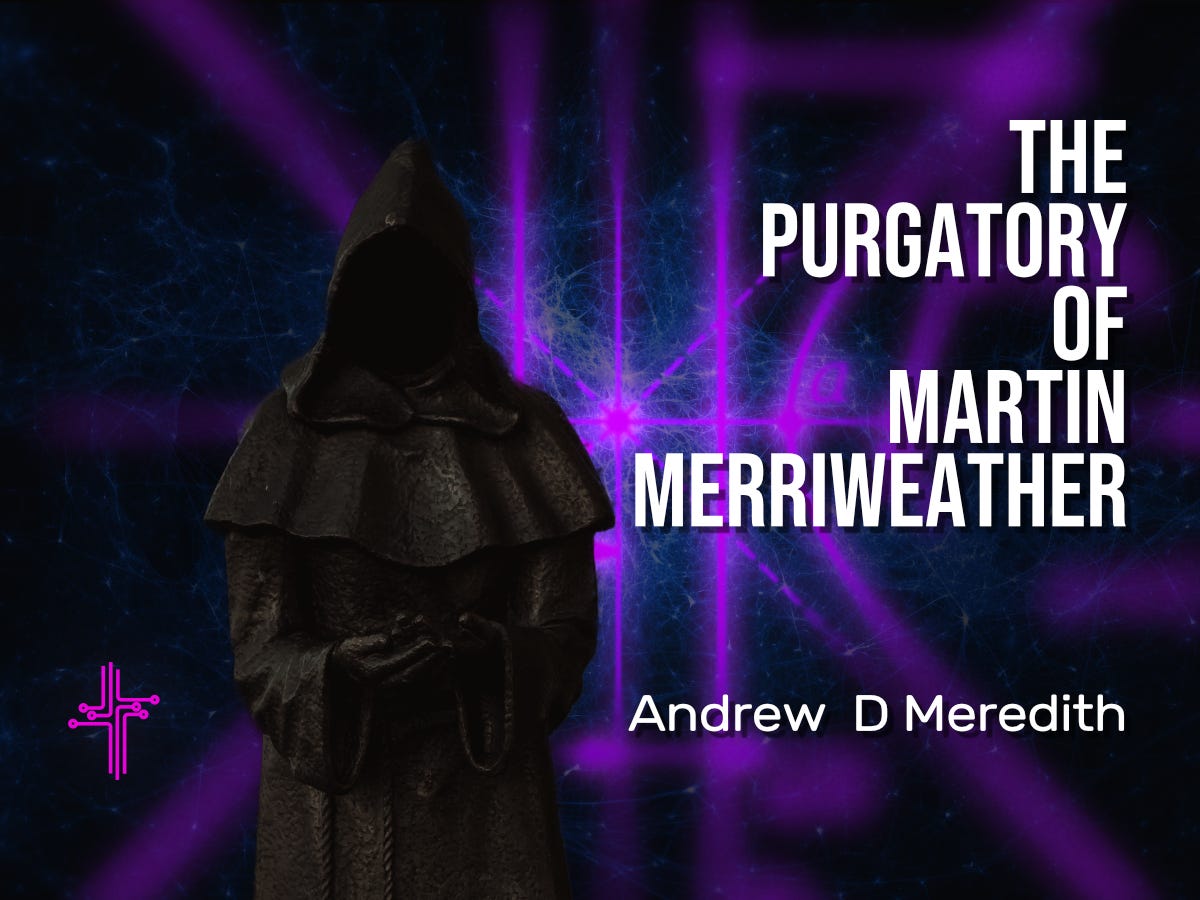
The Purgatory of Martin Merriweather
While the monks of Fair Weather ponder the nature of time, Brother Martin has only an eternity to find its answer.

By Andrew D Meredith
Edited by Yuval Kordov
The metal door slammed against my back, leaving only the black-rocked Hall of Purgatorio before me. A cold and silent place. A place of punishment, deep in the dungeons of New Vatica. The man who put me here a former colleague and friend.
Cardinal Halcyon.
We’d spent years unraveling the mysteries of time travel together at the academy, only for him to betray me. Not only did he abandon The Question, he devoted himself to disproving it, and declaring such studies a heresy. As he ascended from bishop to cardinal, he sought my excommunication. To blot out my name and embarrass me among our peers.
Halcyon was Brutus, Cassius, and Judas Iscariot balled up in one.
His efforts to bring our shared goal under the ecclesiastical heel were successful. But after five long years of trial, there was insufficient evidence to expel me. The only sin they could stick me with was “Unrepentant.”
Cardinal Halcyon had his hands tied.
The council instead allowed me to choose my own method of punishment. It was a pleasure to deny the man the opportunity to publicly scourge my back or force me into a living destitution. Instead, I chose this Promethean Curse, entering the Hall of Purgatorio to select a fate that some deemed worse than death: Immortality.
What better way to continue my research? The cardinal would live and die knowing his enemy still lived on. I could continue the work, and unravel the secrets of time travel. Either I would solve the Question and go back and show him his folly, or eternity would catch up with me, and I, the last man in the universe, would walk through the Pearly Gates and look him smugly in the eye.
Let him fester in that knowledge.
The hall was not a long one. Six arches stood along each side, lit by lumitorches. Above each had been carved a single word.
Above the first seven: Anger, Pride, Envy, Greed, Gluttony, Lust, Sloth.
Next came Deceit and Despair, officially added to the Deadly Sins by the Church Ecumenical Council of 2057. Then Discord and Rebellion, added in 2112 by Pope Errol Paul but only at the compromise of Aloysian, who insisted on bringing it to a full twelve with Oppression. The hall terminated at the thirteenth door, which stood at the end opposite me: Blasphemy.
“You’ve all the time in the universe, Martin Merriweather,” I chuckled to myself. “Let us select this as one chooses a chocolate.”
Each arch, I found on closer inspection, bore a relief carved into its supporting pillars.
Around Pride, Prometheus.
Gluttony, as was to be expected, Tantalus.
Rip Van Winkle surrounding Sloth amused me.
Deceit and Despair, the Brothers Smith, who set off the End War of 2050. David Smith’s gouged eyes, wandering in darkness, surrounded Deceit, while Karl Smith, Despair, had been set to lie under a burning sun in a desert.
And what school child did not know the story of Fredrick Hahn, who stood in for the sin of Oppression. He’d been an obsession of mine as a child. My study of his genocidal rebellion of my ancestors in the first decade of the 22nd century had led to my studies on time travel. I’d often dreamt going back in time to reenact upon him the pain he’d dealt to my grandparents and their families. The relief surrounding the Oppression Arch gave me satisfaction, showing Hahn being eternally flayed by those he had oppressed.
But it was Blasphemy that drew my eye. Above it, there was an idyllic scene, showing a garden, in which toiled monks. Nay, the same monk, going through the seasons, circling the arch, and then at the bottom, being buried, and reborn to begin his toil again.
I did not fancy the starvation of Tantalus, the eternal sleep of Winkle, digging a mine eternally for the greed of Charles Ponzi. But gardening? I did not doubt there would be some catch, but I could not think what it might be. I was known by all as one of, if not the, smartest men in the world. God formed my intellect while in my mother’s womb, and I came out ready to talk and to solve the mysteries of the universe.
But I was no blasphemer. I knew the scriptures better than any man alive, and so, the punishment would be a vapid one.
I would outlast it, and become a scholar gardener.
***
“Welcome Brother Martin!”
I passed through the arch, and there I was, exactly where I pictured I would be. The arch behind me was gone, and instead, a locked wooden door set in a high stone wall. The garden was as idyllic as I’d supposed, with monks of various ages tending. Each wore a brown hood down over his face.
From down the garden path two hooded monks rushed toward me.
“Welcome!”
Beyond them stood a massive monastery, like something out of a history book. And beyond that, the sky. To call it a sky was not entirely true. Rather, a formless iridescence.
“Welcome!” the foremost monk said again.
“What is this place?”
“The Monastery of Fair Weather!” he said. “You are most welcome here, Brother Martin!”
“How do you know my name?” I asked.
“Your arrival has been foretold. We’ve been awaiting this moment. Come, let us show you around.”
He turned and began walking back to the monastery, with a slight limp in his gait. The other monk did not speak, but took up the rear as we walked.
A monk carrying water buckets on a yoke approached from the other direction. My guide suddenly rushed forward before the other had even stumbled, but stumble he did. The monk could not save his brother from striking his knee on the flagstone, but the water was saved. Others rushed to help, and escorted the now hobbling monk away, while another took up the water to deliver it to its destination.
“We’ve few rules here,” the monk said over his shoulder. “First, follow every instruction you are given, and no harm will come to you. Over time you will come to understand why, but know that your elders know what is best for you. Secondly, you are new here, and you will have many questions, but unless you are granted permission to speak, you are to remain silent. The silence allows us all the time we need to think, as we ponder the Question.”
“You know the Question?”
“We do,” the monk said. “It is why we are here. Focusing on our work so that we might continue to ponder the Question requires silence.”
“And yet, your own voice,” I said, “does not seem tired nor lacking use.”
“The elder members of our brotherhood are granted the relief of that Rule. One day you will be allowed to speak. But that will be when our most ancient members decree it.”
We came to the monastery doors.
“You will be shown each room by the Brother here. Observe, but do not speak. He is still a new member of our congregation. He is forbidden to speak.”
The older brother held the door for the two of us and we entered.
It seemed even larger inside than out. There were dormitories, in which many beds were occupied with sleeping monks. Then a refectory in which a few monks ate, each by himself, simple fare, but food no doubt from the gardens. And then we came to a library that bore many a book, but there was more space to be filled. If, like me, these monks have had an eternity to write, I did not doubt my own work would help to fill those shelves.
On we walked, and after what felt like many hours, we came back to the gardens. The old monk from before approached.
“Now you know your way around. When you are tired, you may sleep. When you are hungry you may eat. There are no clocks here, for there is no day or night.”
Another monk approached with a wooden bucket half full of pulled weeds, and put it into my hands.
The older monk next to me gave a nod and walked away.
I took this to be an unspoken assignment and began to gather up the weeds that others had pulled and cast aside. On down the rows I walked, passing hooded monk after hooded monk. It was mindless work, and so I allowed my thoughts to wander to my latest formula in pursuit of the Question: On the Nature of the Time Gravity Anomaly of 2134.
I did this for hours, emptying the bucket into compost bins, and continuing my work. It was the most silence I had experienced in years, and I found joy in it.
After a long stretch, I reached a pile of bramble cut from a particularly thorny berry patch, when another monk, the one that had been observing me since my arrival, shot out with a hand to grab my wrist. I froze in surprise, and he indicated toward the pile, from which a hiss came. Another monk appeared and with a hooked pole caught and disposed of the snake that lay within.
I gave a silent nod of thanks, and continued my work. Almost immediately, the other monk had left me. No, he fled. I do not recall seeing him again.
As directed, when I was tired, I slept. When I was hungry, I ate. Sometimes in the refectory, other times off the vines of the garden itself. And the days, if they could be called that, came and went. Time no longer meant anything, and for that, I was thankful, because I ceased to feel constrained by time, and could better ponder the Question.
Eventually, I was given other chores, from sweeping, to helping chop the vegetables that made up our diet for the cooks who ran the kitchen. Each fulfilled their role. And I felt I was a part of something. No one judged me for getting lost in thought, and no task went undone. When I was lost in thought, and nearly burned a soup I stirred, someone was there, in the nick of time, to ensure it did not. How each could know the exact moment to prevent an accident, I did not yet understand. But it was a comfort that each looked after the other, to allow each to contemplate the Question.
As I tended a fruit tree, plucking worm-ridden apples, my first guide approached me.
“You have done well,” he said. “You have served the brothers with ease, and adjusted as well as can be expected. Thus, it is time for you to enter your first reward.”
I gave him a quizzical look. I’d not spoken in I did not know how long.
“It is time for you to enter your First Observation. A new brother will be coming to join us, and so, you are to don a robe as the rest of us do, and without looking him in the eye, you are to follow me as I introduce him to our brotherhood, and then guide him in through the monastery. Observe. But do not speak. When your Observation is completed, I shall guide you to the next stage.”
We entered the monastery proper, ascending stairs I’d not seen before. In this one each bed took the shape of a coffin with no top. Two monks passed us from the other direction.
“You will sleep here now. These particular beds provide privacy.”
He indicated a door on the other end of the room and together we approached. It was identical to the arch that had led me into the Monastery in the first place. A black curtain of some unknown substance hung there. Beside it hung a robe, like the one the brother next to me wore
“Don these.”
I did.
He was first to enter, passing through the archway without a second glance. I could not help but follow, and walked through only to find myself back in the same dormitory just as two monks entered the room and walked toward the arch.
We passed them.
“Keep your head down as I greet him,” he said, as we exited the monastery. He moved faster, and I could not keep up. The newcomer had arrived, though I’d not been able to observe it, and my companion offered a muttered word of greeting.
“Welcome! Welcome to the Monastery of Fair Weather!”
“How do you know my name?” the newcomer asked.
He followed a script, granting the newcomer the same instructions he’d given me. The newcomer was instructed to follow me as I silently led him through the edifice, and our older companion left us to it.
That done, we came to the garden where, as I had been, he was given a bucket, and began to collect the detritus left by the others.
We did not become tired nor hungry at the same time, so at times I left him to his work and slept or ate. When I observed him and his work from under my hood I considered the Question. I no longer worried about the problems that Quantum Chrono Entanglement had left me, but rather, considered whether the human soul was entangled with time. Do people each sit upon their own timeline? Or was that a Ptolemaic Theory, centering too much on Man?
I was lost in that thought when my charge approached the pile of thorned brambles. A feeling in my gut left me in a cold sweat. My charge reached for the branches, and knew what next would be heard. The snake hissed, and I rushed forward to take hold of the younger man’s wrist. He froze as he realized what I had saved him from. My hood fell back from my face. He was too lost in the moment to look my way, but I saw, for the first time in my observation, his countenance.
The man I observed was me.
I turned and fled as another monk came to clear the snake from the brambles, and the younger one collected the branches with no thought to my leaving. I found a small alcove in a wall, and sat upon the bench, shaking.
“The shock will pass,” the older monk said, coming to sit with me.
“How?”
“You’ll come to understand it,” he said. He pulled back his hood to reveal my own face, but several years older.
“This cannot be…”
“Yet it is.”
“Then, I solve it?”
“We solve it,” he nodded.
“How?”
“I do not yet know. But this I have learned, and this you have now experienced. We do not take a step out of line here, for fear of something changing. Our thoughts are our own. And when we have thought long enough, we’re granted permission to write out those thoughts. Indeed, I am about to pass on to that stage. I do not know the answer to this, but I speculate that the oldest of us is deemed worthy to read all of the books in the library, to consider the collected thoughts of all of these versions of ourselves. In that, they can finally solve the Question, and our vengeance will be complete.”
“To rub it in Halcyon’s face?”
The man across from me nodded.
“Now, we are going upstairs. You’ll observe my passing into the next stage, and you will continue to observe. And when the time comes, to take my place.”
***
For days I reeled. It was possible. Time travel was possible. I could hardly believe it. And I had been the one to solve it. Or, at least, a future me. It also answered the age-old question of whether time could be changed. In many ways, my future self had given that a resounding “no.” I was responsible to keep my past selves safe, by watching what my future selves did to prevent all accidents. But he’d also indicated that with all of us thinking of various stages of the Question at once, we might provide tangents. That was the frustrating thing. Did we think of different things? Did we deviate in our logic? Or did each and every action feed the inevitability of the answer? I would solve the Question. And then, I can only assume, I would build the time machine myself.
Having done so, I could go back, and prove it to Halcyon, and see his face as I did so.
Of course, that also meant I would need to solve the Spatial Differential. Locking a fixed point jump to the same location should be easy enough, but time travel to a different point outside of the monastery would be harder, especially since I’d no idea if the monastery was even located in the dungeons of New Vatica.
I took my next assignment to heart, and watched everything. I found an observation deck with short-ranged telescopes and ledgers. At times, other versions of myself were stationed there as well. We all worked around each other in silence. At first, it was a confusing dance, but soon I started to realize that no bad step could be made. At times I’d come onto the observation deck and realize that a version of me from the past was there from a few sleep cycles before. I could almost grasp the feeling like none of us were separate, but all of us were of one mind. One spirit.
Never with regularity, often when I came to my observation station, I would watch my earliest version arrive at the wall, and the older monk would greet him, and my next earliest version would guide young Martin through the monastery. If there was no day and night, and no time, there was definitely a loop upon which we all lived.
After an unknown amount of observation, I was tasked with cleaning the chapel. That I’d not been there before struck me as odd. I entered and found little that needed dusting. It was as though it had been built only yesterday. The saint on display above the altar bore no name. His visage old and his symbols that of a sailor, or an observer of the weather.
Saint Fair Weather? That’s what I had been told when I’d arrived. This was the Monastery of Fair Weather. A place where weather never happened, yet our food grew.
Did we not only solve the Question, discovering how to turn back time, but to stop it as well? Had time stopped?
I had to find out.
I proceeded to stay awake as long as I could. With no clock, I could not gauge how long it had been. But I watched when my earliest self arrived, and then kept time as best I could. One day passed, then two, and then I grew weary and slept. No sooner had I awakened and returned to my station when young Martin arrived at the monastery once more.
I determined to stay awake longer, bringing food to occupy me, and I made it longer. Sometimes shorter. And each time I slept, I awoke to young Martin arriving.
When I sought to find the first old monk who spoke to me, I never could. I gave up trying to find him, and instead tried to determine how long each “day” was. I could not, for no matter how long I was awake, for a single or many days, sleep brought about my arrival once more.
Did my sleep reset me? Or was I being manipulated by a future version of myself to arrive at a predetermined time?
As best I could tell, the longest I stayed awake was ten days.
At times, I stopped caring. It was a triviality. And yet…
I was in the chapel again. I stared up at the visage of the Saint of Fair Weather.
“Yet, you wonder,” a voice said. The older monk, the older me, sat down in the pew next to me. “You wonder if contemplating time as it passes by you will play into your calculations, our calculations, in the future.”
“What do you contemplate?” I ask.
“Perhaps I ought not tell you, but I recall this moment and my telling you. So I must. Perhaps in that, I will answer my own quandary.”
I sat in silence.
“This monastery sits here, with hundreds, or thousands, of versions of ourselves, contemplating time. Contemplating whether we can change time. Contemplating, therefore, the oldest church debate.”
“Free will.”
“Precisely.”
“If my future selves prevent harm from occurring,” I said, “it could cause a butterfly effect, erasing all the work they’ve done, and yet, we cannot help but follow the predestined path.”
“And yet,” he regarded me with a smirk. “If you—your future you—is what determines the action, willing it to occur, is it predestination? Or the Free Will of the Collective of Martins?”
His smile faded and we sat in silence, thinking on that.
“That is all I’m going to think about now,” I say.
He nods to me. “You’ve a madness to pass through now, until you reach this point. But I promise you, you will come out of it. Or else how can I be here, in my right mind?”
***
He was not wrong. That new question, as related as it was to the Question, consumed me.
I walked the halls of the monastery, a haunted figure. I even tried to see if I could change things. I set up harmless pranks: I shifted tiles for past and future selves to trip upon. At times I was caught up in my own traps. But it was a madness. I’m not sure I slept or ate, as time crossed over on itself. On myself.
I soon realized that I was being thwarted by some other version of this prankster, or else why did I have no recollection of a mad monk in the monastery?
It became a game. Mad versions of myself caught in an endless battle of wits. In many ways, those days of madness were a wash, but more so, they were one day. One single moment that folded in on itself.
I awakened in my bed, with the clearest head I’d had in a long time. The entire monastery was empty. No soul to find. Only myself. The sky outside in many ways was unchanged. Yet there was something different about it. It seemed darker.
On I wandered those empty, hallowed halls, alone for the first time and no longer mad.
I did not want to see the gardens. I did not want to see my other selves working. I just wanted to be alone. I wanted choice in my actions. I dodged several of the traps Mad Martin had set, and out of spite I even undid a couple of them. That task complete, I came, at last, to a door I have not seen before.
Entering it I found a set of spiral stairs. Up they went for what felt like miles.
At last it let out into another long hallway. The same hallway that looked out over the orchard. It had to be. It shared all the stained glass I could often see from without, but that also meant I was no higher above the ground than when I entered the stairs.
On I walked down that seemingly endless hall, and came finally, to a door. It swung open before I could open it myself.
The table within held ten hooded monks in comfortable chairs. I came to stand at the bar before them, which reminded me of my trial before Cardinal Halcyon.
It had been too long since I’d even thought of him and those halcyon days of foolishness, debating the nature of time.
“What do you know of time?” someone next to me asked, echoing my thoughts.
“What did the Cardinal know of time?” another asked.
“What is time?” a third said.
I did not speak. My voice had been out of use during my madness. Instead I watched and observed them as we began to argue.
In some ways I recalled sitting in a few of those chairs. How did I not fully recall if this had already happened?
“Stand tall, Martin,” the figure at the head of the table said. “It is time for you to make an accounting for the time you have spent here at Fair Weather.”
“What is there to say that you do not already know?” I croaked.
“Well said,” someone responded.
“I have struggled with the Question, as we all have,” I explained. “And I feel close to an answer. But I fear that if I speak aloud those thoughts, you will correct me, and in doing so, prevent your having learned that fact in the first place.”
A round of argument ensued.
“Thus preventing our correction through a Grandfather Paradox.”
“Unless we do and it does not undo the action with paradox.”
“How can we know if we have tried and succeeded?”
“We cannot. A paradox would iron itself out.”
“Thus,” the head of the table said, “You are now to pass through your next portal, returning to the beginning. You’ll no longer observe, but save. Perhaps you’ll even find things changed.”
“Changed?” I asked. “Return?”
“You have spent too much time alone. Time here in the After.”
“The After?”
“You were set aside from the ten days of the Beginning, as we have been. We can all remember our time spent in Madness. Perhaps you’ve been here in the After time to prevent damaging the time of the Beginning. I do not yet know.”
“Nor I,” another said.
“I do not understand…” I said.
“You have made your calculation of the length of the Beginning, as we call it. Ten days, approximately. Those who exist in a council further along than us, we assume, have adjusted and chosen when and where we each awaken after each sleep. Where you are now, we call the After. Only a few of us are here, working in tandem. Once our time is completed here, we will pass to the next. What those there call it, I do not doubt we’ll find out.”
“And what do they do there?” I ask.
“What we all most desire.”
“To read the solutions,” I said. “To see our work.”
The men around the table murmured.
“There is so much hope to be found,” I said, “in knowing we march toward our success.”
“Even,” one asked, “If that means we have no free will?”
“We do,” I said with a finality.
“How do you know?”
“Hope,” I said.
“Then he is ready,” the head of the table said.
They escorted me from the room and into another I had not seen. There ran countless rows of upright boxes with apparatus, tubes, and electrical lines. Some were better built than others, while newer ones had been made with precision. We walked to the last one, and they opened it.
“Enter,” the one next to me said, indicating toward the box.
“These are different than the door portals,” I said.
He nodded.
I turned, and backed into the sarcophagus. It reminded me of the old images of pharaohs’ final resting places. I was, it appeared, to be buried, knowing I would be reborn, just as the relief on the Arch of Blasphemy showed.
***
I do not enjoy my memories of my time in my madness. Nor did I relish the thought that I would one day return to that same lonely time as a member of the council. Worst of all, that sarcophagus I was placed in haunts my dreams. The transference back to the original ten days was one of the worst things I’d ever experienced. But what I can say is that I’d been changed. When I was in my madness, time ceased to exist. So did self. I was, and in many ways still am, each and every one of those versions of Mad Martin. I am convinced that the only reason I passed from the madness is because I had some sort of apotheosis, and became all versions of the Mad Martin. And that was certainly the case now that I was elected to be one of the older leaders who protected the younger versions of myself in those original days. I am not even sure how best to describe it.
One day I was pulling carrots, and a moment later I was in the orchard catching a younger Martin before he fell from a ladder, nearly breaking his leg. He did not. But I twisted my knee. For long after I would have a limp.
Another time I was both mopping a tile floor, and writing down my thoughts on the Question at the same time.
It did not bother me. In fact, I felt that if I dwelled upon it too much, I’d go mad once more.
I had forgotten what it was like to eat when I had been mad, and thus, I no longer ate. I do not recall if I even slept. Instead, I shifted from one Martin to the other. Over and over again.
When I finished a book full of notes, I’d place it on the shelf. There was no organizational method. How could there be? I was working on those thoughts from all those different moments. I was tempted to read them. But when I did, some other Martin would clear their throat, and remind me that this was our purpose: to continue forward, yet never leave these halcyon days.
***
The moment had come. I saw my younger self. That one who would watch as I greeted the new Martin. He fled from the garden, having saved the first Martin from the snake. He sat shaking in the alcove as I walked by.
I instructed him to follow me. To don the robe. To enter the arch. To keep his head down as I greeted New Martin at the wall.
Everything happened just as I remembered it.
“Your arrival has been foretold. We’ve been awaiting this moment. Come, let us show you around.”
I left them off to their tour through the monastery and made my way to the chapel. I comforted another Martin. We spoke, on the nature of time and free will. He left and I looked up at the gold plated Saint of the Fair Weather.
Fair Weather. Me. It was Martin Merriweather. Then I was to become a saint.
That of course, would require appearances to the living. Miracles…
Was not every time I revealed something to a younger Martin not this? Is not the answering of the Question not a Miracle? Yes. I would be canonized, if only by the brothers here. This once more fortified my hope.
A door opened beside the altar.
I did not hesitate, but entered.
***
The After was a strange place. In the halls, the Mad Martin roamed. The council discussed, and the older Martins who had graduated past that worked on building the machines. But I spent most of my time, indeed, we all did, reading the journals.
Sometimes I would be half way through one of the journals before realizing I’d read it before.
It did not help that the concepts and theories were almost always identical, and I accepted that. I’d suspected this was likely. After all, it was my hand. My theory. My working out of the how. In many ways, it was another stage of madness. I’d written the same book hundreds of times, and now I read and dwelled upon them. At times I was summoned to take one of the ten seats on the council, to judge Mad Martin, sentencing him out of his first madness, and back into another, to become the writer and protector.
How long was I there? Who can know? But it was when I touched that book’s spine that I knew this day would be the moment.
It was electric. Perhaps the eyes of all Martins watched as I took it, and went to sit in one of the more comfortable seats.
It was the same as all the others, save for that one line. A line I’d crossed out with the pen, to mark the idea as faulty.
There may be a spiritual element to the act of looping back on your own timeline.
It struck me that this was the only time I’d ever written this, and I’d dismissed it then. But what if?
I closed the book and stared about the library.
How could it be so complicated, yet so simple? If time was stopped, it would prevent the death of the person, and thus lock the soul in place. If the soul was locked in place, then time would stop for me. Did some version of myself lock himself in a moment, and provide this opportunity for the rest of us?
I ran to the council hall. There was only one chair left, at the head of the table. I quivered with anticipation. How and when would I do this act? How could I sacrifice myself? How could I lock myself into this time and provide the soul that would lock time?
My ears roared, and I could hardly pay attention. The Mad Martin came and left. The others stood, and left the room, and I was alone. The door to my right opened. The black curtain rustled. Beckoned.
Onward I went, to my chosen fate.
***
The door led to a place I’ve come to call the Between. There, the Martins are the engineers and builders. From the others I learned first how to make one of the machines, and then later, how to adjust them. It was a great joy to run calculations. To finally understand just how long I had been there.
One Martin’s notes indicated that the entire course of events happens over thirty-nine days. The ten days at the beginning, another twenty days in the After, and then this particular Martin estimated there would be ten more days. I’m not sure how he’d come to that, but I had no doubt I’d soon understand.
I helped others as they asked, and eventually made my own Machine. It was hideous. But, it worked. I entered it, and came back out at the same moment as I’d left. My next one I was able to link to the first, and I emerged three seconds before I left.
This took me into what I often referred to as my Third Madness. Time once more blended, and I became a master of my craft. I became all of the Martin Engineers at once. I was able to create and install the Portals everywhere around the monastery. I don’t recall traveling back to the beginning to install even those early ones, but I did. And when I finished my final portal, I felt my work done. I knew, because I’d chosen to make this one of polished metal, and caught, I think for the first time, my reflection.
I was old. Older than I realized, and could not recall when I’d had time to age. But I had.
I dismissed that sinking feeling, and checked my calculations once more. It assumed the fixed point of this Purgatory of Blasphemy as built under New Vatica, and I was able to pinpoint the location of my destination.
I looked around. I was alone. This was my moment.
I activated the machine and stepped through.
***
It was our study off the dormitory room. Halcyon and I had shared it at the university. Our notes littered the main table. They looked like foolishness to me now. Scribblings of younger men who had no true understanding of the nature of Time, but long desired the answer to the Question.
I took up one note, nostalgia settling on my mind as I saw Halcyon’s words. A Halcyon who had called me friend and brother.
They were… right. Halcyon had solved the equation. The Question.
Impossible.
I looked to the date: June 22nd. The same day he’d rushed into my study room at the library and announced he’d given up on the Question.
Anger, and envy overtook me. A desire to burn the page.
No.
Vengeance.
I took up the pencil beside the journal. With one stroke, I could prevent him from solving it. It would be his destruction.
I changed the solution as the door opened, and young Halcyon entered.
“Who are you?” he said.
I turned and fled back through my portal and away.
I did not return to the monastery, but found myself somehow locked in one of the sarcophagi, with only a pair of holes to see out of. Looking through them, I found I was in the chapel, looking down on the pews from above the altar.
After a few hours, a Martin entered, and sat in contemplation. Others came and went.
Time passed.
“Fair Weather,” one Martin muttered before leaving.
Time.
The Beginning came and went. Martins arrived and left.
Ten days passed.
The Mad Martin haunted the chapel alone, yet not alone, as he sought to outsmart himself.
Time.
The council members of the After came and went. Some sat and took notes in journals. Some considered me.
Time.
None came. I was along in those last ten days, and I, for the first time in I do not know how long, felt hungry.
I grew weary, and wondered how I could have brought about my own death?
When had I installed this sarcophagi within the statue of the Saint of Fair Weather?
A figure entered the chapel. He was not a day older than the day he’d sentenced me.
Cardinal Halcyon.
“Well done, Martin,” he said, looking up, eyes locking on mine through the holes of the statue.
I was too weak to answer.
“I entered that room as a young man, and saw you flee back through the portal, and knew that my calculations were right. I had solved the Question back in those days as a young man. You tried to change my formula before you fled, but failed. I fixed it the moment you left.”
How had he entrapped me like this?
“For years I waited,” he said. “I chose to leverage power, and become a high ranked member of the church, knowing somehow, despite all odds, you would also solve the Question. I had this monastery built. Took you to trial knowing you would choose to come here. But how? Because after this moment my library of scholars will scour every note you have ever written during your incarceration, I will go back and explain it to myself. All of this you have done, spending untold years, and I had only to wait these forty days for you to starve to death. I answered The Question, but you perfected it in this monastery of blasphemy.
“It took the five years of your trial to build this. The master stroke was the chapel here. It only has the one portal, built to receive you when you returned from our dormitory as lads.”
The anger of this betrayal coursed through me. I hoped that some version of Mad Martin might rush in and murder this man.
“How fitting the sin of Blasphemy be your true nature. Not Blasphemy of time travel. It was never a heresy. No. The blasphemy that you die wearing the visage of a saint. That you probably sat in this very chapel and worshiped yourself. There is not a single holy scripture in the whole monastery. Didn’t even take the time to try and replicate one from memory? No. Like Dante’s Inferno, your punishment here was the reenactment of your sin in life. Self-worship. You thought yourself the smartest man on earth. And yet, I solved the Question while a youth, and you’ve spent a lifetime reliving the same forty days, only to die, knowing that I will take your work and do great things.”
He stood for a moment, taking his victory in, before turning to leave. “You thought me the betrayer, only to find you betrayed me. All is circular, and we are left to answer for our own sins. No last rights for you, I think.” With a nod to the altar and the visage of St. Fair Weather, he left.
All of this time in the monastery, and it was by his design? All of it for naught? I had chosen purgatory, promised I would live, even in torment, in an immortality. Halcyon was supposed to die. Not I.
If there was a Fourth Madness I passed into, I do not recall, because neither I, nor a future me, would come after to remember. But I’d learned to stop eating and sleeping before.
Perhaps I would live in this moment for eternity, as hungry as Tantalus.
As sleepless as Rip Van Winkle.
Flayed by Oppression at the thought of the friend who it turned out I had first betrayed.
The ninth circle of hell, and that frozen lake of ice, where Brutus, Cassius, and Judas Iscariot are caught in frozen rictus, might soon find two new companions in Martin Merriweather and Cardinal Halcyon.
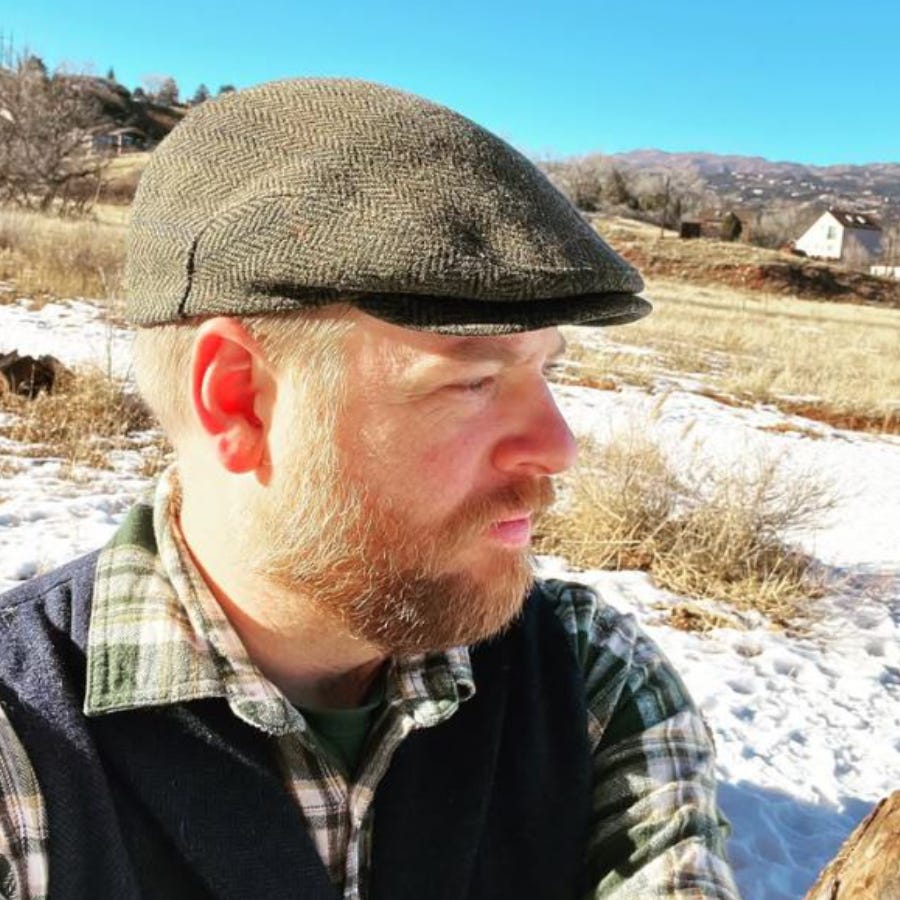
Andrew D Meredith’s journey has taken him to many fantastical places. From selling books in the wilds of western Washington to designing and publishing board games for Fantasy Flight Games/Asmodee. He now resides in the Colorado Rockies, and has committed to the quest he was called to so long ago: the telling of fantastical tales, and bringing to life underestimated characters willing to take on the responsibilities no one else will.
Copyright © 2026 Andrew D Meredith & Incensepunk Magazine
All rights reserved
No part of this publication may be reproduced, distributed, or transmitted in any form or by any means, including photocopying, recording, or other electronic or mechanical methods, without the prior written permission of the author, except for the use of brief quotations in a book review.
This is a work of fiction. Names, characters, organizations, places, and incidents either are the product of the author’s imagination or are used fictitiously. Any resemblance to actual persons, living or dead, events, or locales is entirely coincidental.
 | A guest post by
|