


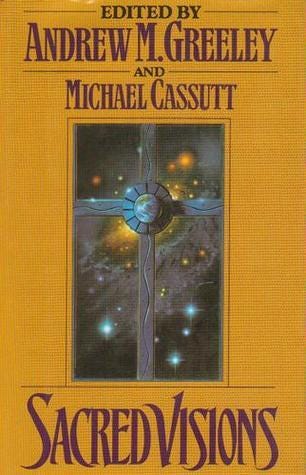
When I was first alerted to this collection in the Incensepunk Discord (by a reader who found it randomly in a thrift shop of all places!), I was shocked my research hadn’t already uncovered it. How could there be a Catholic science fiction anthology that I had missed! And published by Tor even! Of course, once I recovered from the shock of my google ineptitude, I ordered the book (from a used book reseller—it’s both out of print and physical only).
The anthology is edited by Andrew M. Greeley, a Catholic priest and author, whose own credits include several science fiction novels (quickly added to my TBR list, to be sure). The book’s stories include eight reprints by authors of varying fame—two of them being the original shorts that became A Case of Conscience and A Canticle for Leibowitz—and four original stories commissioned specifically for the collection, including one by Gene Wolfe!
Here’s my thoughts on the twelve stories (fine number for a Catholic collection!), followed by my overall impression.
Gus by Jack McDevitt
A strong opener for the anthology, Gus explores the advent of AI and its collision with theology, a topic we look at often here at Incensepunk Magazine! It even uses the concept of an AI recreation of a saint, part of the premise of Andrew Gillsmith’s The Venerable Wolfe parts 1 and 2.
Gus introduces us to the titular simulation of St. Augustine through the lens of the skeptical Msgr. Chelsey, a rather old school instructor at a Catholic university that is notably less old school.
Through Chelsey’s hostility towards the AI, he and Gus change each other in ways neither would have imagined possible. The story goes beyond simply questioning the wisdom of such machines, exploring instead the horror experienced by the program itself—a copy of a human mind, trapped in a disembodied machine, perpetually isolated, unable to touch or taste or smell, living solely at the whim of whomever may wake it. And from there it goes deeper, asking what we might do for love of something we hadn’t thought capable of such love.
Personally I’m not huge on the idea of created machines developing spiritual souls, but it’s a topic worth looking into and the story does so in a surprisingly touching way.
The Pope of the Chimps by Robert Silverberg
Less officially incensepunk than some of the stories in the collection, Pope explores a long-term experiment in a clan of chimpanzees who have been taught to communicate with each other and their handlers via sign language.
In order to avoid tainting the experiment, the keepers avoid talking about big topics like death and religion with the apes. But when one of the handlers begins dying of cancer, they decide it is time to finally broach the topic of mortality.
What ensues as the chimps learn that their gods are mortal and begin developing a faith of their own is a moving meditation on the possible origins of faith in early human culture, and a time-lapse view of how religion can develop, spread, and transform.
Curious Elation by Michael Cassutt
Other than the twist at the end, Elation offers a much less speculative story than the rest of the collection. We follow Jeff, a highly successful sleaze bag who has stumbled back to his quaint midwestern home town.
Through the story, Jeff is pulled almost magnetically by guilt back to his former childhood friend Gary, a once-promising student whose life collapsed in an instant in their Catholic school when an accident left him paralyzed.
As the story unfolds, we slowly learn that Jeff feels he is responsible for Gary’s situation. It’s unclear whether he truly repents, or merely wishes for absolution, but I shan’t spoil the ending for you. Suffice it to say, both Guilt and Forgiveness are properly Catholic themes and the story spends plenty of time in them.
Trinity by Nancy Kress
Well, it wouldn’t be 90s scifi without at least one needlessly horny entry. In this case, it goes all-in on the taboo and even dives headfirst into sibling incest.
Setting aside the uncomfortable parts, I didn’t find the narrative particularly compelling, either. Rather than the power of doubt that we like to explore at Incensepunk Magazine, it instead leans on the need for certainty.
I don’t want to spend much time on this one, but it solidly lands at the bottom of the pile if I’m ranking the stories in the collection. A bummer that the only (I believe) entry in the book by a woman is such a stinker.
St. Theresa of the Aliens by James Patrick Kelly
Another of my less favorites, Theresa is about a secular communications manager whose cousin-in-law is a Catholic nun bent on exposing communist aliens.
Overall the story just feels bitter. Sure, the Church has plenty of history to account for, but if we’re going to make up new crimes they should feel more believable. The neo-Catholics in Altered Carbon feel much more realistic than a smug terrorist media nun. Granted, it was written in the midst of the Cold War so perhaps it’s more a matter of not aging well, but I prefer to see stories that don’t end with a sardonic “America has got religious again”.
Our Lady of the Endless Sky by Jeff Duntemann
A priest on the moon, contemplating the Blessed Virgin. Hm, where have I heard that before?
Father Bensmiller is the sincere pastor of a lunar colony, responsible for establishing a lavish church dedicated to Our Lady.
But when disaster strikes in the fragile colony, his job becomes very different than he had imagined. Rather than the stewarding the expensive chapel, Bensmiller has to learn to pastor to people, and in so doing, learns that God can work in mysterious ways.
Interestingly, the story ends with almost the exact opposite commission as my own See of Tranquility (linked above). But then, the Earth each respective cleric left behind is equally opposite, so perhaps that makes sense.
The Seraph from Its Sepulcher by Gene Wolfe
An original Gene Wolfe short was one of the big draws for this anothology for me. While I haven’t read the entire Book of the New Sun yet (I know, I know…), I have read the first two and have enjoyed what I’ve gotten through so far and was excited to get to a more… contained… story of his.
Seraph is, fittingly, one of the most confusing but rewarding stories in the anthology. It follows a xeno-archaeologist as he travels to a mission chapel on a faraway planet that was once home to an enigmatic, and now extinct, race of aliens known as Seraphs. The mission is cared for by a solitary priest, Father Joseph, who is an expert on these strange beings.
The prose of Seraph is truly engaging—while most of the stories are top-class writing, this is one of the few that overcame my attention-addled need to check notifications on my phone and I read the story in a single sitting. Like most of Wolfe’s work, it leaves you with few answers and lots of questions to ponder. It’s hard to even talk about without giving much away, Definitely one of the stand-out stories in the collection.
A Case of Conscience by James Blish
The novel version of Conscience is one of the classics that I found early on in my incensepunk journey. I often tout it for its perfect ending but disparage it for its, well, mid middle. So I was very curious to read the short story version that was Blish’s original vision for the work.
Ultimately, this version is basically the same as the first act of the book. Surprisingly, the ending I hold in such high esteem doesn’t seem to have been a consideration at all in the original story! And expectedly, neither is the strange and rather drawn-out act two.
There are a few minor changes I noticed in the short version of Conscience, but it’s been a few years since I read it and I wasn’t doing a side by side comparison anyway. All the main thrust is still there, and the details seem to have been modified to set up the longer plot line of the novel.
The part that I especially noted as absent was any hint of the Manichaeism heresy that plagues Father Ramon in the novel and is the main thrust for the resolution. The fact that it is absent in this makes me wonder if Blish was clued into the problem by readers of the story—or perhaps continued to puzzle on the theological implications even after initial publication—and took the opportunity to clear his name when he expanded the story!
As a standalone story, it works quite well. If you’ve already read the novel, you won’t get much more out of this, but if you’re looking for a shorter read, it’s easy to see why this was popular enough to get expanded upon.
Xorinda the Witch by Andrew M Greeley
And the second horniest of the stories in the collection is somehow the one by a Catholic priest. The 90s were a wild time!
Xorinda is about a sniveling, cowardly zealot in a post-apocalyptic future Earth where some form of magic is practiced by primarily young women. Nondos is some form of princeling and a true believer of a largely unexplained future religion with no tolerance of witchcraft.
Nondos has been tasked by his church leadership (who seem to perhaps be rather taking advantage of his wealth and dedication) to sail across the world to round up accused witches to bring back for their inquisition.
While Nondos believes himself immune to temptation of flirting with evil, everything starts to go awry when they are attacked by pirates and he succumbs to asking the titular witch to use her evil powers to protect the ship.
There’s the threads of a nice look here at the power of love and empathy of religious rigidity, but it’s so marred by the reddit athiest-tier made up faith and rapey undertones of Nondos’ sexual attraction to Xorinda, his prisoner, that the moral lesson doesn’t really land.
A Canticle for Liebowitz by Walter M Miller Jr
If you’ve read the first act of Canticle, you’ve read this. If you haven’t, what on Earth are you waiting for? Close this window and go do it.
The Quest for St Aquin by Anthony Boucher
One of my favorite entries in the book, Quest follows pilgrim Thomas on a commission by the Pope himself in an apocalyptic future not dissimilar to the setting of A Canticle for Liebowitz.
Thomas must traverse the hostile wasteland seeking the relics of a new folk saint to bolster the dying church. To aid him in his quest, he is given the help of an AI-powered robot donkey (robass, as Boucher cutely refers to it) who loves talking theology.
But the Technocracy that controls the scattered remains of humanity are not very tolerant of Christians, and nor are the backwater townsfolk Thomas must question on his way to find the relics.
The story concludes with some reflection on the tension between faith and reason—or perhaps, their union, as a few twists towards the end pull Thomas between temptations as he lives out several of Christ’s parables in his travels.
And Walk Now Gently Through the Fire by RA Lafferty
The editors have saved the strangest for last, and I for one am glad for it! This is a hard story to review, as much of the enjoyment of it is puzzling out what exactly is going on. But enjoyable it is, so I’ll do my best to give a spoiler-free summation.
A young Queer Fish (what are those? I’m not going to tell you!) farmer meets his coming of age encounter with a demon disguised as a drug tripping cow. A visit from a monk bearing a curious letter. A brutal attack as the Queer Fish await a stranger from across the sea. And finally, a gathering that brings with it hope.
Each section is interposed with an entry from some sort of encyclopedia, almost reminiscent of A Hitchhiker’s Guide to the Galaxy, which helps us piece together this trippy setting.
Once you figure out what’s going on,Walk lands with a hopeful message on the perseverance of the church and God’s promise that the Bride of Christ will not fail, even when all looks grim.
Final Thoughts
Sacred Visions is a fantastic anthology, very much in line with what I first envisioned before pivoting to a monthly magazine approach instead. While the focus of the collection is solely on Catholic scifi and we here at Incensepunk Magazine are interested in stories that explore other faiths as well, readers who want to explore the future of religion will enjoy this book.
That said, some of the stories show their age more than others—while Canticle is a timeless classic, Xorinda is definitely a relic of a different age. I’d also love to see more perspectives; at a glance all but one of the authors are men and all appear to be white. Surely at least some Latin American authors like Borges could have been included if it were a priority. But alas, that too is a product of age.
Still, the collection rests now among my favorite anthologies, and not just because it hits so squarely on a theme I’m obviously very passionate about. Even of the few stories I didn’t love, the writing was excellent, and they were far outnumbered by entries that I absolutely adored.
Sacred Visions is a must read primer for fans of Catholic incensepunk.