

As it Is in Heaven
Amid the struggle for life on Mars, a young woman and her mother discover Life itself

By Laura Pavlik
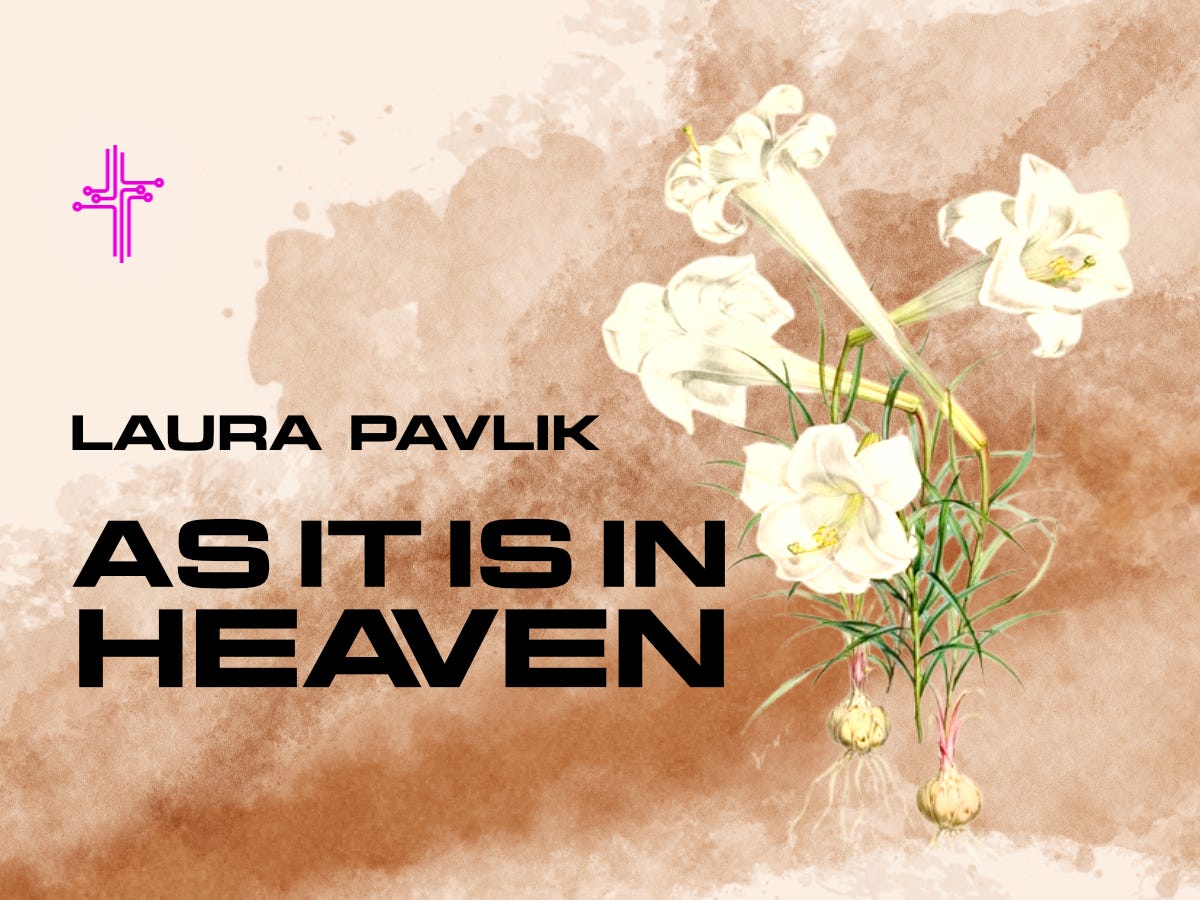
Father Herman’s face was like a lily blossom. It wasn’t the color–the contrast between the weathered brown of the face and the smooth white of the flower could hardly have been more stark. Yet there was something there all the same. Looking back, I believe it was something hopeful that I saw in both of them, something humble, trusting. Patient.
The face, and the lily. I recognize that in the ordinary course of things, I would never have seen either one.
***
My mother held my hand, almost dragging me down the hallway, grinning every time she looked back to meet my eyes. A few times a year, she would bring me to her lab: whenever she managed to grow one of the more exotic specimens from the seed bank. Every time, the excitement radiated from her so strongly that I couldn’t help but be carried along.
She wasn’t really supposed to be experimenting with seed bank specimens–agricultural investigation at that point was intended to focus on food and medicinal crops–so my anticipation of something I had never seen before was compounded by the thrill of the almost-forbidden.
She scanned her badge and fingerprint, then pulled me after her into the Agriculture Lab.
The Ag Lab was always my favorite place in the compound; even when my mother didn’t have something special to show me, I would take any excuse to come and visit her. After being surrounded by the living green of the lab, the gray monotony of the rest of the compound seemed even more drab, making a return like this something of a resurrection.
My mother was still moving quickly in her excitement, but I resisted her rush as we entered the rooms of plants: rows of hydroponic lettuce, strawberries, herbs, and peas; pots of tomatoes, peppers, potatoes, and carrots growing in a mixture of terrestrial and local soil; various kinds of moss and pine trees planted in undiluted local gravel. I loved each growing thing–filled with a child’s instinct for the sacred, I wanted to pause and greet each one.
But the one my mother had brought me to see was indeed the best of all.
“I couldn’t get it to grow in even a 90-10 soil mixture,” she whispered before she opened the door to her office. “So I had to put a couple in the hydroponics to replenish the seed bank.”
A flower larger than any I had seen before, as white as light itself. Six petals opening like a star. I couldn’t take my eyes away. It was minutes before I dared to reach out with a careful finger to touch: first just the leaves, and then finally, reverently, the petals.
“Careful of the pollen,” my mother warned. “It stains quite badly if you get it on anything.”
I begged her to take me back every day until the blossoms finally withered. On my third visit, I brought my tablet. My mother didn’t want me to take a picture, given that the existence of the lily wasn’t exactly sanctioned, but she had no opposition to me drawing it. So I did, again and again.
I still have the sketches: line drawings, mostly, but some with color. I was only a child, but even then I had a talent for looking closely, and the essence of the lily can be seen in my drawings.
The essence that I would later recognize in Father Herman’s face.
***
The first day of class, he blocked our tablets. It wasn’t unheard of for teachers to do, but most reserved this unpopular intrusion for tests and in-class essays. Never before had it happened on the first day.
I was doodling a pattern of leaves when the bell rang and my tablet went dark. Like most of my classmates in third period terrestrial literature, I looked up in annoyance.
“Hey!”
“What’s the deal?”
“Did he just…?”
The man at the front of the room held his silence for what felt like a long time, although without our tablets, we had no way to measure. Gradually the complaints and mutters died away. We just looked at him.
He was dressed all in black, a shapeless robe that I didn’t yet know to call a cassock. This in itself was odd–the rest of us all wore regulation brown, mostly handed down from older compound residents. He wasn’t particularly tall or particularly short, certainly not particularly young or handsome, but my eyes were drawn to his face. I wondered if anyone else could see the beauty there, how he almost seemed to be glowing as he looked at us.
But perhaps it was my eyes only, primed by the radiance of the remembered lily from my childhood, that were able to see it.
Finally, he reached for his tablet, which he had left on the desk behind him. The class began to murmur again.
“Of course he’s still going to use his tablet.”
He stopped moving and turned back to face us.
“My name is Father Herman. I had hoped to read to you.” He paused, studying us. “Ah, well. Perhaps once we know each other better. For today, then, I will tell you a story.”
If we had ever before in our lives been given any experience with stillness, we would have been transfixed as he began to speak: “The Greeks imagined a time of darkness and shivering cold, long, long before any of us were born…”
As it was, we tried. He was a gifted story-teller, and most of us wanted to listen. He told us of Prometheus, who had stolen fire from the gods to give to men. It was like nothing we had heard before–there had never, as far as we knew, been a god on Mars. But most of us had never seen fire; we had always known the heat that came through the compound’s vents, the light from the LEDs on the ceiling and from the screens of our tablets. Cold and darkness would be like leaving the compound, walking the bare surface of our planet, exposed. We knew just enough to imagine, to be drawn into the story.
But we didn’t know stillness. I kept absently tapping my tablet, expecting at least to see what time it was and whether I had any unread messages. The dark, unresponsive screen was distracting. The girl in the seat behind me swung her legs, accidentally kicking my chair every couple minutes.
“So I ask you,” Father Herman concluded, “did Prometheus do right?” Now he did pick up his tablet and glance at the time. “We have ten minutes remaining. Please respond in writing to be submitted at the end of class.”
He unblocked our tablets and a sense of relief swept through the room. 1135 hours, read my screen. No new messages. I had almost forgotten what we were supposed to be writing about.
Did Prometheus do right? In giving men fire? What a question!
“Fire is the beginning of technology,” I wrote. “Maybe even a symbol for it. Without technology, we wouldn’t be here–why would the gods want to keep us in darkness?”
***
From my twelfth birthday onwards, I had worked with my mother in the afternoons. She taught me how to test the nutrient content and composition of the local soil in the pots where the pines and moss were growing. I had my own document where I would record the data every week. Each pot was identified by a 10-character code, but I also gave each tree a name, because I loved them.
“Good job, Penny,” I would whisper, stroking soft needles.
“Keep breaking down those rocks, Fraize.”
She explained about the tomatoes, how she hoped that generation by generation, the plants would change, evolve to be more at home on Mars as she decreased the ratio of terrestrial soil a little at a time. I had another document where I drew their leaves and flowers, watching the shapes change gradually over time, becoming something different, something that could survive here.
***
Sometimes, when I ran out of ideas for my sketches, I went to the observatory. It was the only place in the compound where a person could look out at the sky, and sometimes I would draw inspiration from the patterns the stars traced out above us at night. More often, though, I would draw the faces of the others who came–I had noticed that the faces I would see in the observatory were more interesting than the average face in the compound.
I drew the older people, a few probably still from the first generation. Their faces were like the pine trees I loved so much: rough and weary, but still reaching upward. Some of them had such longing in their eyes when they looked at the stars, beyond my skill to capture.
I would draw the couples, my age or a little older, nervous anticipation filling their faces like buds about to burst into flower.
A few other people would come alone, like I did. Some of them had questions on their faces, some only wonder. I drew their tears, when our loneliness became too much to bear. I would hide in one of the corners, watching and drawing.
It was after 2430, the first time I saw Father Herman there. Knowing that my mother would already be asleep, and unable to bear the thought of returning to our apartment alone, I had stayed with the stars long after all the faces had left, tucked in my little corner, sketching nothing in particular.
I am sure Father Herman did not see me, hidden as I was, but I had been in that room for hours–plenty of time for my eyes to adjust to the dim light cast by the stars–and I could see my teacher’s dark-robed figure well enough. His eyes looked so tired.
Immediately, I stopped whatever sketch I had half-heartedly been working on and gave my entire attention to drawing his face.
He had begun by tracing a repeated figure across his torso–touching head, chest, right shoulder, left shoulder, and then bowing to touch the ground several times, but after that he stood quite still: face tilted upwards, arms stretched out to the sides as he whispered his prayers. He spoke too softly for me to make out his words, but I could hear the anguish in his tone; I could see it on his face.
I drew quickly, wanting to capture everything before he moved, but when I had finished that first drawing, he was still standing there, whispering up to the stars. I drew him again, more slowly this time, and then again. An hour passed, and still he stood motionless. I noticed, though, that by my fifth drawing, something had changed. The anguish on his face had lessened, replaced by the peace and patience that I had noticed that first day in class. His voice still sounded sad, but there was no longer any desperation in it.
After that chance encounter, I stayed late in the observatory many other nights. Each time I did, Father Herman would appear sometime between 2430 and 0030. He would pray for hours, long past the time when I would doze off in the nook where I had hidden myself.
I had dozens of drawings of him, but I kept coming back. Every time, I watched until the peace came back to his face. In those moments, the darkness itself felt warm, as though a Presence was there with us there, underneath the stars. I started to live for that Presence, for those elusive moments when I felt like I was not alone.
***
My mother was in trouble. For years, she had been indulging in unsanctioned experiments, growing beautiful things in her spare time, in the secrecy of her office. So long that she had stopped being quite so cautious.
This time, she had grown a rose, not in the hydroponics, but in a 50-50 soil blend. The day it bloomed, I was out in the lab with another one of the student interns. My mother was so excited that she didn’t wait–she showed the rose to me, and to the other intern as well.
I know she meant my mother no harm, but that particular intern was not a wise person to trust with a secret, and word spread around the compound. Things may have turned out differently if she had meant harm and gone straight to the mayor with it–the mayor was not an unreasonable man, and if the matter could have been kept private, he may have let my mother off with a warning.
But given that everyone knew, he had to crack down. Our survival in the compound required efficiency and discipline. If one person was allowed to waste precious public resources pursuing her private interests, if others saw her and followed suit, we might not have enough supplies to last until the next biennial shipment from Earth. The compound needed food, not flowers.
My mother lost her job in the Ag Lab and was assigned instead to cleaning duties.
“I can’t argue with his reasoning,” she told me, “I should have been better. I was selfish.”
Day by day, I watched her wilting. Without her work–her real work–a listlessness came over her.
At first, she would ask me about the plants–I was considered as innocent in the matter as the other intern, and thus had kept my internship. My mother would inquire after a particular pepper hybrid, a strain of wheat she had high hopes for. She would ask to see my drawings of the tomato leaves; she would run her fingers over their outlines.
As the days passed, though, she grew quieter and quieter. She would ask a question, and then in the middle of my answer her eyes would become distant. I started finding her ration bars only half eaten. I counted the bars we had left and found too many.
I considered trying to sneak her into the lab, just so she could see something beautiful again, but the doors were programmed to allow interns access only during our assigned after-school work hours. I took pictures of the blossoms of some pea plants and messaged them to her. She didn’t reply.
Eventually, she stopped speaking altogether. She wouldn’t have eaten at all if I hadn’t made her sit at the table and placed bite-sized chunks of ration bar into her mouth. I could barely get her to chew.
Five weeks since she lost her job. Ten days since I had heard her voice.
I decided to do something desperate. I took her to Father Herman.
***
At 2400, I woke her up. I half expected her to protest, which would at least have been something, some sign of life. But there was no protest, no spark even of curiosity in her eyes. She stood like a doll as I slipped her arms into the sleeves of her sweater. Her hand was limp in mine as she followed me through the corridors without eagerness or resistance. Doubts chased each other through my mind: what exactly did I expect Father Herman to do? What if he wasn’t even there? But I remembered the countless times I had watched him, had seen the torment on his face replaced by peace as he stood in the starlight. Anyway, I had no other plan. My love for my mother and my gratitude for the beauty she had shown me gave strength to my steps.
He was there, of course, in the observatory, standing still with his arms outstretched, his lips moving silently in prayers. He lowered his arms when he heard us coming, brought his eyes downwards from the stars to rest on my face.
“Kasha,” he said, simply. “And this must be your mother?”
“Yes.” I struggled for words. Somehow I had failed to consider what I wanted to say when we got here. “Father Herman, I don’t know if you heard. How she lost her job in the Ag Lab. And then… she… I don’t know. It seems like she stopped caring about everything. I was hoping maybe you.. I don’t know–”
He nodded as I spoke, and when he replied, it was to my mother. “It is a hard thing, to lose the only source of beauty you can see. But Yuti, all is not lost. He has written His image also on our faces.”
I hadn’t expected him to know my mother’s name, but it must have been included with my academic records in the computers.
She didn’t answer him, so he turned back to me. “How long has she been like this?”
“Ten days,” I said. “She hasn’t spoken for ten days.”
“I will pray for her. This is what you desire?”
“Please.”
“Oh Heavenly King,” he began, “The Comforter, the Spirit of Truth, You who are everywhere and fill all things. Come and abide in us, and cleanse us from every impurity, and save our souls, O Good One.”
He continued to pray, his words washing over me like the cleansing wipes my mother used to bathe me when I was a child, but more flowing. Like the water in the hydroponics, but sweeter, more nourishing. The prayer lasted a long time. I wish I could say that I heard every word, or even that I managed to keep my body reasonably still. I did not. I shifted from foot to foot, and my mind wandered from the unfamiliar notion that a God might exist who was “the Great Physician and Healer of souls and bodies” to my work in the lab to a project I had due for school and back again to a plea to “heal her every ailment and forgive all her sins.”
But I did manage to keep my eyes on my mother’s face. I could never bear to draw what her face looked like before that prayer, else I would have tried to sketch the transformation, the way her eyes gradually filled back up with life, the gentle smile that crept shyly onto her face like a seedling uncurling.
When Father Herman had finished, she thanked him–the sweetest words I had ever heard then, though I have since heard sweeter.
“Thank you. It means a lot to know that someone cares.”
He looked at me and then back at her. There was a question on his face, though he didn’t speak it. He said merely: “Go in peace.”
So we went, leaving him there, bathed in the pale light of the stars.
***
“Today,” Father Herman announced at the start of class, “I am going to tell you a story that is a bit different from those you have yet heard from me. Different, because I believe this one is true.”
I was feeling shy after having disturbed him the previous night, and didn’t want to meet his eyes, though I could feel him looking straight at me. With my tablet screen dark, I could only pretend to be intensely interested in my fingers.
“In the beginning, God created the heavens and the earth–”
“You believe in God?” someone interrupted. “I thought they screened for that in immigration.”
“My work here is to tell stories,” Father Herman replied. “I explained all this on my immigration application. I only wanted to explain why the way I tell this one might seem different.”
And it was, I noticed as he went on. He spoke as though he were reciting, and the quiet joy on his face was more intense even than usual. His words filled my mind with pictures, and my fingers itched for the stylus of my tablet. I wanted to draw the sky suddenly filled with stars, the land with plants, the sky with birds, the sea with fish. Things that had never interested me, that had only been pictures on a screen, were made beautiful by the longing in Father Herman’s voice. The man shaped from the earth, the woman shaped from the man–this I did draw later, in chemistry where our tablets were not blocked.
And then the snake: “Did God really say?”
The woman took the fruit and tasted its sweetness. God called in the coolness of the day.
Father Herman was still looking at me. “Who told you you were naked?”
And then the earth was cursed because of the man, and the woman was given pain, and the snake was destined to be crushed.
“We have twenty minutes remaining in class,” he concluded. “Choose one person: the man, the woman, or the snake. Respond to the following: did the punishment fit the crime?
I wrote about the snake. The man and the woman were more or less tricked, and twenty minutes wasn’t time enough for me to sort through the intricacies of that morality. But the snake was the spark–if any punishment was deserved, it was his. I wrote about the necessity of preventing more harm; I wrote that I would have crushed him instantly. Why would a god be willing to wait?
***
I sat nervously at the table in our apartment, expecting my mother to be home from work any minute. I hadn’t seen her in the morning–she left before I woke up–and I wasn’t certain how long the effects of Father Herman’s prayer might last. When she finally walked in, I was sketching on my tablet. Lilies. Over and over again, lilies. Perhaps that was the only way I knew yet to pray.
My mother was humming. She looked me in the eye and smiled. I felt the tension melt from my body.
“He was right, Kasha! It is enough, the beauty on people’s faces. It was enough, for today. I’d like to talk with him some more.”
“We can!” The words bubbled out of me, released by my relief, my eagerness to do anything to help her stay okay. “He teaches my literature class! I’ll talk to him tomorrow, and we can set up a time to meet–”
I was interrupted by a knock. My mother and I looked at each other. People didn’t visit much at all in the compound, and they certainly didn’t visit us.
Father Herman looked a bit sheepish when I opened the door.
“I know I wasn’t invited,” he began, “but I was wondering if it would be okay with you if I blessed your apartment. It’s a tradition in the Orthodox Church. For everyone, really, but I thought especially in your case. To protect against evil spirits.”
I half expected my mother to object. I half expected myself to object. We were scientists, the two of us. We probably didn’t believe in prayer, much less in evil spirits. But I didn’t want to be rude to Father Herman, and my mother–she was nodding already.
“That would be wonderful,” she said with all her old confidence. “Please come in.”
He did. And then he began to take wonders out of his bag: things that are commonplace to me now, but rarities in the Martian compound. Two little cards printed with pictures; a paintbrush, a bowl, and a little bottle of water–it looked as though it were made of glass. He propped the cards up on our table. One showed a man with a circle around his head; he was holding a book with writing in a language I didn’t recognize. The other showed a woman holding a child. They also had circles draw around their heads, and they wore that same peaceful expression I had come to associate with Father Herman. Faces like lilies.
“Who are they?” I asked, touching the paper gently. It was so much softer than a screen.
Father Herman smiled. “The man is the one who crushed the serpent’s head. The woman is his mother. If you like, you may keep the icons.”
“Thank you,” I whispered.
We stood, the three of us, and he began to pray. Again, the words washed over me, surrounding me. Again, I didn’t completely understand.
And then he was singing, a hymn I didn’t understand at all: “When Thou, O Lord, were baptized in the Jordan, the worship of the Trinity was made manifest.”
He dipped his paintbrush into the water, which he had poured into the bowl, and started flinging it around the room. My mother and I watched, amazed at the extravagance. Water in the compound was for drinking and washing, too precious to throw at the walls.
When he had finished, he splashed us also, and then he bent and kissed each picture–each icon. Then he reached into his bag and pulled out a week’s worth of ration bars.
“Please, take these,” he told my mother. “To give your body a bit of extra strength with which to support your soul. And both of you: feel free to visit me if you’d ever like to talk.”
He left us with the icons and the food, the holy water still dripping down our faces.
***
My mother started to pray.
I would half wake up, some mornings, around 0500, long before I needed to get up for school. As though in a dream, I could hear her whispering: “Holy God, Holy Mighty, Holy Immortal, have mercy on us.”
I would feel safe, then, somehow, as though our whole apartment was protected by an unseen Presence I almost recognized, and I would nestle back into the covers and fall back asleep.
She must have been going to see Father Herman, because after a few weeks, another little printed icon appeared in our apartment next to the other two. This one showed the same man, the One I would later learn to call Jesus, the One who had crushed the serpent’s head. In this picture, He stood on a pair of crossed wooden beams, grasping the hands of a man and a woman, as though he were pulling them out of a hole. When I asked my mother, she explained that these were the ones from Father Herman’s story–the man Adam and his wife Eve–and that Jesus was pulling them out of the deepest hole, out of hell itself.
I started visiting Father Herman too, after that. It was always strange to step inside out of the gray corridor; his apartment was so full of things. Shipping from earth was a premium, so most apartments were like ours: bare of all but the basic necessities. I still don’t know how Father Herman managed to afford it all. His walls were covered with icons. Mostly printed cards like those he had given us, but also a few painted on wood. A shelf on the wall was lined with bottles: holy water, oil, wine. Besides the typical ration bars like those he had shared with my mother were unfamiliar little packages wrapped in foil.
“Freeze-dried bread,” he explained. “I use it for Holy Communion when I celebrate the Liturgy.”
He always answered any questions I had, and he told stories too.
“The Faith is not a set of facts–it is a story God is writing on the cosmos. How can you learn by any way other than the Way the Master teaches?”
I loved him. He was so gentle, always giving. Often, he would send me home with a few extra ration bars for my mother and me.
“Aren’t you ever hungry?” I would ask.
“Always, Kasha. But not for food.”
***
“I’m going to be baptized.” My mother said it shyly, as though she wasn’t sure that I would approve. I looked up from the paper on epigenetic changes in Martian tomatoes that I was writing for my internship. “This Saturday, Father Herman says. And after that… Kasha, he says I should go to Earth.”
To Earth. It wasn’t impossible to go to Earth, but it wasn’t something you could do lightly either. My mother would have to apply to the mayor for special permission, and if her petition was granted, it would be almost impossible to come back.
“But why?”
“The Church is on Earth, he says.”
“But he’s not on Earth!”
She didn’t seem bothered. “You’ll have to talk to him about that. But Kasha… will you come with me?”
“To be baptized, or to come to Earth?”
“I was hoping maybe both?”
There was laughter in her voice, and her eyes were glowing, like they used to when she would bring me to see a new flower she had grown. When I followed her to the flowers, I was never disappointed.
***
I got to the observatory before he did that evening. I wanted to be alone for a while before I decided. I stood while I waited and prayed the simple prayer Father Herman had taught me: “Lord Jesus Christ, Son of God, have mercy on me, a sinner.”
I looked up at the stars. The beauty I saw there, the beauty of the lily, the beauty on Father Herman’s face. I wanted to be part of that beauty too. I wanted to love God the way Father Herman did. I wanted to be baptized.
I stood still then, quietly, wrapped in the light of the stars, rejoicing in the certainty of having decided. I didn’t notice Father Herman approaching until he was right in front of me. There must have been something written on my face, because he took one look at me and smiled.
“So, you also will be baptized. Glory to God!”
“Yes, Father,” I answered. “But first I wanted to ask you one thing: you told my mother she should go to Earth. I don’t understand.”
“The Church is on Earth.”
“That’s what she said, but I still don’t understand–you’re here on Mars. Aren’t you part of the Church?”
“Oh, Kasha.” He made the sign of the cross and murmured under his breath: “For I could wish that I myself were accursed from Christ for the sake of my brethren…” And then louder: “Come and sit with me.”
He drew me over to the chairs along the wall. For a moment, he looked as though he were going to speak right away, but then he let the silence stretch. Finally, he pointed upwards.
“That one, that bright speck in the heavens, that is the place where God took on flesh. It is written that at the end of days, He will return there, and His Glory will shine from one end of the sky to the other. They argue about what that means, in the seminaries. Some say of course the whole universe will see Him, for His Spirit is everywhere present and fills all things. Everywhere surely includes Mars.”
He paused again, still looking upwards.
“It is hard to be a Christian here, Kasha. All the ways in which God sends us his joy are muted. The flowers blooming in the spring, the song of the thrush and the nightingale, sunlight sparkling on water–” his voice caught, but after another pause he was able to go on. “I know He’s here. It’s just harder to remember. I don’t want that for you. I want you to know that you’re surrounded by His love. And the churches–I want you to hear the choir singing, see the candles, smell the incense. If it’s possible at all, I want that for you.”
A long time, then, we sat in silence.
“You should go home now, Kasha. Fast as much as you can between now and Saturday. Join your mother’s application for passage to Earth. And remember me in your prayers.”
***
Saturday morning, we stood solemnly before the icons in Father Herman’s apartment. Whether through Father Herman’s prayers or simply the mayor’s pity, our application to immigrate to Earth had been approved unusually quickly, and just in time. The orbits of Earth and Mars align for efficient travel only about every two years, and we had barely made the cut-off for this cycle’s shuttle. We were queued up to leave the next day.
“I wish you could wait and do this on Earth,” Father Herman told us. “But I would not have you make such a dangerous journey unbaptized. Are you ready then?”
We nodded.
Father Herman breathed into our faces and traced the sign of the cross over us, then laid his hands on our heads. “Let us pray to the Lord.”
And we did. We renounced Satan, the serpent from the story. We declared that we had united ourselves to Christ. We bowed to the Father, and to the Son, and to the Holy Spirit.
Father Herman blessed the water–not a huge tub like would have been used on Earth, but a large bowl, all that the three of us had been able to spare from our drinking rations over the last few days. He anointed us each on the forehead, on the breast and shoulders, on our ears, our hands, our feet.
He didn’t move quickly, but somehow I had imagined it all taking longer, as though the importance of the ceremony would lengthen the moments. It was already time.
“The handmaid of God, Katherine, is baptized, in the name of the Father, and of the Son, and of the Holy Spirit.”
Three times he poured water over my head. I will always remember the extravagance of that water, pouring over my face, my hair dripping with it.
Then he handed me a uniform–bleached from brown to white. “The servant to God, Katherine, is clothed in the robe of righteousness, in the name of the Father, and of the Son, and of the Holy Spirit.” I went to change in Father Herman’s small bathroom. When my mother came out after me, also dressed in white, her face was shining. I wondered if I looked the same.
Father Herman anointed us again and then we were walking around the bowl of water, which he had placed in the middle of the floor.
“As many as have been baptized into Christ have put on Christ, Alleluia,” he sang, his voice breaking.
***
The first time I took communion was on Mars, directly following my baptism. In that small, quiet room, I had looked into Father Herman’s face and tasted Christ.
The second time, I was surrounded by lily blossoms. My mother and I had only been on Earth for a few weeks, and everything was so new: I still marveled every time I stepped outside and felt the wind on my face. I was learning to stand in the shade of trees taller than houses and to taste the warm sweetness of strawberries.
But stepping into the shimmering darkness of that church was something so beautiful I could hardly bear it. It was Pascha, the Feast of Christ’s Resurrection, and the nave was full of candles, full of people, full of icons. All I could do was stand and absorb the smell of the incense, the joy of the people singing. If I had moved, it would have been too much for my senses to bear.
I tasted God, present with me in fresh bread and red wine, and the words of the Paschal homily echoed in my ears: “The table is richly laden… let no one go hungry away.”
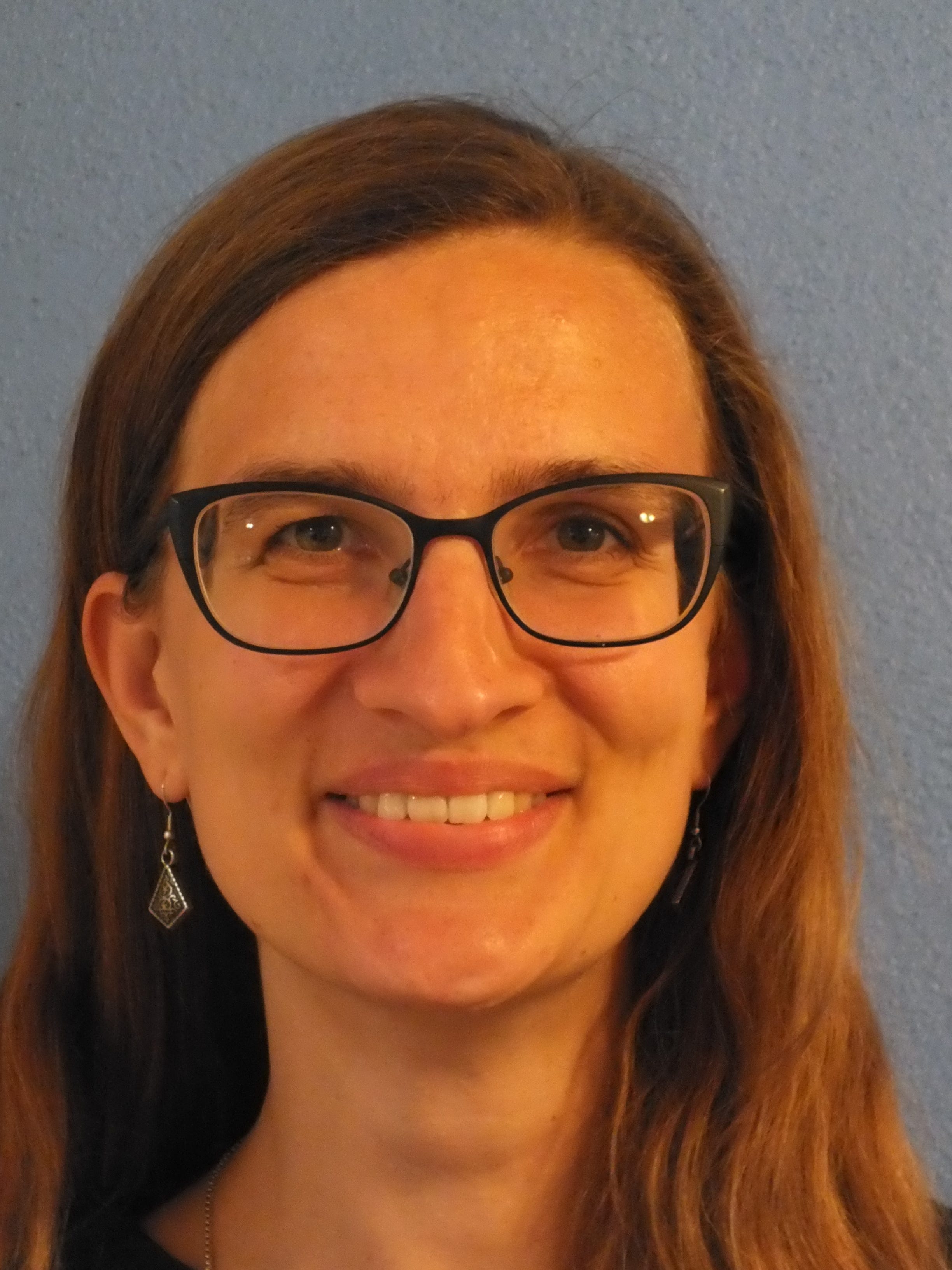
Laura Pavlik thanks God for questions. She loves asking them, answering them, and critiquing the answers of others. This seems to be the common preoccupation among her vocations: science teacher, wife, mother, and writer.
Copyright © 2025 Laura Pavlik & Incensepunk Magazine
All rights reserved
No part of this publication may be reproduced, distributed, or transmitted in any form or by any means, including photocopying, recording, or other electronic or mechanical methods, without the prior written permission of the author, except for the use of brief quotations in a book review.
This is a work of fiction. Names, characters, organizations, places, and incidents either are the product of the author’s imagination or are used fictitiously. Any resemblance to actual persons, living or dead, events, or locales is entirely coincidental.
 | A guest post by
|
Very nicely done, and very accurate in terms of Orthodox customs and ceremony. I am pleasantly surprised to find that I will not be the only person coming at it from that perspective.
Wonderful story of resurrection unto new life! The characters of Kasha, her mother, and Fr. Herman were wonderfully realized. A perfect story for the Winter Pascha!